

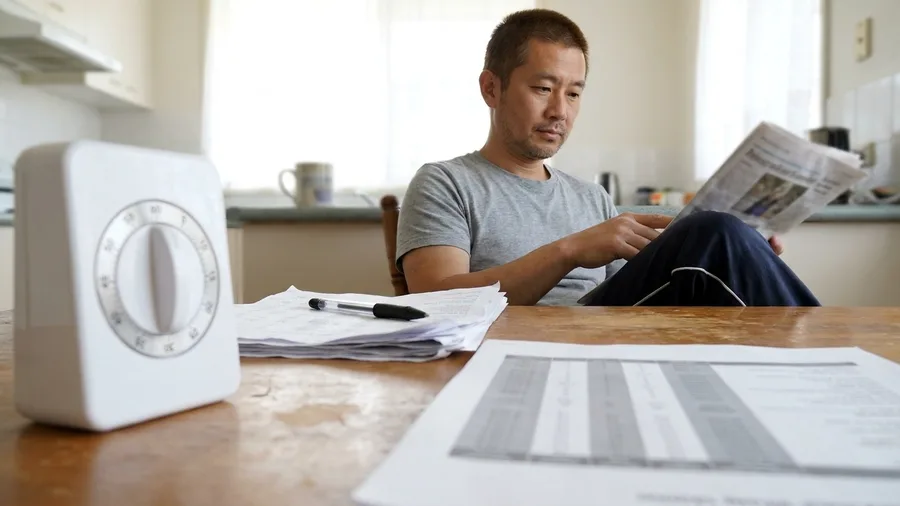
The second Sunday of January 2020, the timer on my kitchen table in Columbus said 29:41 and my spreadsheet had eleven holdings and no instructions. I'm 41 and work in operations, and for years I'd been the guy checking his 401(k) at red lights, which is not a review, it's a reflex with a login screen.
So I gave it boundaries instead. Thirty minutes, four times a year, second Sundays in January, April, July and October, a fresh tab labeled with the year, five numbers and one written note. Twenty reviews later the count surprised me: six trades total. Fourteen of those check-ins ended with a line reading "checked, nothing to do."
The useful question for anyone told to review regularly is not whether quarterly feels productive. It's whether fixed dates create decisions that survive a bad week and replace the urge to log in and trade.
Quarterly earned its place for me only because the calendar did the deciding. Whether it earns one for you depends on what you're pointing it at, and that's the test this piece is really about.
Second Sundays in January, April, July and October, and five numbers written down: balance, allocation, expenses, contribution rate, one note. That's the setup. Whether you need all four dates is what the next few thousand words are for.
Thirty minutes, four times a year, was enough

My whole review was a calendar reminder and one spreadsheet tab, not a research project. The reminder was already sitting on the second Sunday of January, April, July and October. I sat at the kitchen table, set a 30-minute timer on my phone, and opened the tab labeled for that year – 2020 through 2024, one tab each.
Five checks, in the same order, every time. Balance. Allocation against my 80/20 target. Fund expense ratios. Contribution rate. One written note about anything that looked off.
That was the entire ritual. Five numbers and a note, and the timer never ran out.
Add it up: twenty reviews at half an hour each is about ten hours across five years. Then three more hours reading fee disclosures and fund documents before I understood them well enough to act on. Call it thirteen hours for five years of knowing where I stood.
I want to be honest about why I set it up that way. A few years earlier I'd tried to review my accounts and ended up scrolling through fund pages for two nights, confused, then closing the laptop and not opening it again for a year. The 30-minute timer stopped that. If the five checks were done, the review was done, even if I still had questions – those went in the note for next time.
The size of the routine was the part that made it survivable. A research project you abandon. A half-hour with a timer, you finish.
Fourteen of twenty reviews ended with no trade

Nothing changed in most of them, and the note at the bottom of the tab usually read something like "checked, nothing to do." I counted at the end of 2024: six of the twenty reviews produced a trade. The other fourteen ended with that single line and the spreadsheet closed.
Thirteen hours of sitting down for six decisions sounds like a bad trade until you look at what the quiet quarters actually caught. In Q3 2021 the contribution rate had quietly fallen to 9% after a payroll change I never noticed, and I put it back to 12%. Two reviews later I found that a fund I'd held since the rollover had changed the index it tracked, with no notice to me, and swapping it out was one of the six trades.
By late 2023 my stock share was drifting toward the 5-point band set out in the plan, and the review flagged it before the autumn rebalance did anything about it. None of those were urgent. All of them would have gone unseen for another year if I'd only looked in December.
The honest answer in most quarters is that there is nothing to do, and the review is a check on the plan rather than a chore list you have to finish with a trade. If you want the short version of that discipline, these hard-earned money lessons strip budgeting, saving and debt down to what actually matters.
There is a real counterweight, though. If sitting down with the numbers makes you want to move something, four times a year is too often. Once a year is the better calendar for that reader, because the fewer dates, the fewer chances to talk yourself into a trade.
| Item | First review, Jan 2020 | Last review, Dec 2024 |
|---|---|---|
| Portfolio balance | $182,000 | $263,000 |
| Holdings | 11 | 4 |
| Blended expense ratio | 0.58% | 0.11% |
| Cash inside the portfolio | $3,000 | $24,000 |
| Trades made | 0 | 6 |
| Time spent on reviews | 30 minutes | ~13 hours total |
The calendar did the work, not willpower

I had one rule, and it did more for me than any amount of good intentions: anything alarming that came up mid-quarter went into the spreadsheet note and waited for the next scheduled review date. No logging in to check. No acting on the headline. The note was the pressure valve.
March 2020 was the test. The note that month records the drop and, plainly, the urge to sell, with the April review date circled next to it. I did not wait – on 23 March I sold $9,400 of an international index fund between dates, on feeling. The April review wrote that up as the one break in the rule.
Through 2022 the fixed date held. Q1 2022 the balance was down about 11%, and the note reads, exactly: 'no action, re-read the plan in July.' No trade. The date did the holding.
A fixed date beat a vague intention for one reason: the reminder showed up before the news cycle did. Willpower sets its time to look after the headline hits, when you're least steady. A calendar sets it in advance, in a calm week, at a kitchen table with a timer. The date, not the willpower, decided when I looked.
That's the case for a calendar over keeping an eye on things. The eye only opens when something's wrong.
💡 PRO TIP
Set the date before you need it
Pick your four review dates on a good day, not during a sell-off. When the calendar reminder shows up, it is the plan talking, not the market.
Eleven holdings became four, and the fees fell

Eleven holdings became four, and nothing about that happened fast. The consolidation started at the second review, not the first – January's job was just to write down what I owned and what it cost me to own it. When I saw the same total-market exposure sitting in two overlapping index funds, plus a small 0.9%-expense fund I'd bought years earlier and never looked at since, the spreadsheet made the case in one column.
Two reviews and three of the six trades did the work. That's it. Fourteen months to go from eleven down to four.
The slow pace was the point, and I didn't know that going in. Each move waited for a scheduled date, so the consolidation never turned into a trading project I could sneak extra decisions into. Sell one fund at a July review, check the result in October, roll a leftover account in the following spring. The account had room to sit between steps, which meant I could look at each change with the timer off and decide whether it had done what I expected.
By December 2024 my blended expense ratio had fallen from 0.58% to 0.11%. The blended ratio is just a weighted average of what every holding charges you per year, and cutting it that far on a balance near $220,000 is roughly $1,000 a year that stayed in the account instead of leaving it.
Here's the part that matters if you're deciding whether to do this. Count your holdings and their expense ratios first. If two funds track nearly the same thing, or one is charging you eight or nine times what a plain index fund charges, that's a list you can work through – one item per review, not all at once.
What the fee cut was worth
Blended expense ratio on an average $220,000 balance
A five-point drift band caught what I'd have missed

A 5-percentage-point band was my only rebalancing rule, and in five years it fired exactly twice. I set my target at 80/20-80% stock, 20% bonds – and promised myself I'd only act when the stock share drifted more than 5 points off that, meaning past 85 or below 75. Drift means the mix moves on its own as one side grows faster than the other, not that I did anything.
In spring 2021 stocks had run hard, and my mix was sitting at 85% equity. At a scheduled review I sold the U.S. equity index inside the IRA and bought the bond index, pulling stocks back under the band. In autumn 2023 it ran the other way: the 2022 drawdown had left stocks low, so I sold bonds and bought equity to bring the share back to target.
Two trades in five years. Everything else was new money doing the work.
That's the line worth remembering. When you're contributing steadily to a smaller balance, your monthly or per-paycheck contributions do most of the rebalancing for you, and a band can sit quiet for years. A rule that checks drift and stays silent is doing its job. A calendar that has you trading to feel productive is a different machine entirely, and only one of those two saved me money.
If your plan rebalances automatically, or you hold one target-date fund that does it internally, you may not need a band at all.
Rebalancing rules: scheduled vs. opportunistic
Rule-based (what I used)
- Act only when drift exceeds 5 points
- Check only on scheduled review dates
- Rebalance inside the IRA first
- Write the reason in the note
- Triggered twice in five years
Calendar-based (what to avoid)
- Adjust whenever the market feels wrong
- Check whenever news looks scary
- Trade in the taxable account first
- No written rationale
- Triggers every quarter
Cash became a line item instead of an afterthought

Cash got the same treatment as everything else: it earned a slot on the list of five numbers, and I stopped treating it as the loose change left over after the investing was done.
In January 2020 that money market balance was $3,000. Before building that cash up, it helps to run a quick emergency fund check so you know which dollars are safety and which are portfolio. By the December 2024 review it read $24,000, and I could tell you which review added each chunk.
The reason wasn't a call on stocks. I changed jobs in 2023, the runway between paychecks got shorter, and at the July review I wrote down a higher cash target and moved toward it in steps rather than in one afternoon.
That money sat separate from the emergency fund on purpose. The emergency fund was for the roof and the transmission; this was the slice of the portfolio I wanted boring and reachable inside the plan, and I counted it in the allocation so the 80/20 math stayed honest.
Here's the part that matters for anyone copying this: none of it happened in a scary week. Each increase was decided at a scheduled review, written in the tab, and left alone until the next date.
A cash balance set in a panic is a market call wearing a safety label. A cash balance set on the calendar, with a number and a reason and a date, is a plan.
If you only have $500 in cash inside your accounts right now, put it on the five-number list anyway and write one line about why it's there. That line is the whole difference.
Six trades in five years, one I'd take back

Cash grew that quarter because of a job change and a shorter runway, but one other move in that stretch came from my stomach, not the spreadsheet. Five of my six trades were boring: two funds merged into one, an expensive fund sold, a stray account folded in, and two rebalances the drift band called for. Each one was decided at a scheduled review, written in the tab, and executed the following week. The sixth was not.
On the morning of 23 March 2020, the news was ugly and my hands were faster than my rules. I sold $9,400 of an international index fund inside the IRA, between review dates, with no trigger behind it. That holding is up about 60% since, which leaves roughly $6,000 I put on the table by reacting instead of waiting for the second Sunday in April.
I had already run the tax question past a CPA before the first trade, so I knew the mechanics of what I was doing. Knowing the mechanics did not stop me from selling on a feeling. That is the tinkering test, and I failed it once.
The rule that came out of it fits in one line: no trade gets made unless the 5-point band or a fund fee triggers it, and any urge gets written into the tab first and sits there until the next date. Fourteen months of reviews have passed since, and the rule has held every one of them. Write your own version of that sentence before you need it, and put it at the top of the spreadsheet where you cannot miss it.
Ten hours total, and the fee bill halved
Thirteen hours across five years. That's the entire cost of the routine, and against a fee bill that fell roughly $1,000 a year, I'll take that trade every time.
Twenty reviews at 30 minutes comes to about 10 hours. Add 3 more spent actually reading fee disclosures and fund documents, printouts on the kitchen table with a pen, because a 0.9% expense ratio is easy to skim past on a screen. Call it 13 hours over five years, about 2.5 hours a year, or a long lunch.
Here's the fee arithmetic, because it's the part that turns effort into dollars. My blended expense ratio went from 0.58% to 0.11% on an average balance near $220,000. That gap is about $1,000 a year that stayed in the account instead of going to a fund company. Compounded over the years I still hold these accounts, it's real money, though I won't pretend I can tell you the exact figure by 2035 – returns aren't guaranteed and my balance won't move in a straight line.
What the time did not buy: no market timing, no return worth bragging about at a cookout, no trading edge. If a lower fee bill and fewer decisions doesn't sound like enough payoff to you, that's a fair read on your own life, and an annual reminder is plenty.
Thirteen hours bought two things. A cheaper portfolio, and a written process I can hand to my spouse or a future advisor and say 'this is how we decide things.' That second one doesn't show up on a statement, but it has kept me out of the market more times than the first.
The five-minute quarterly check
Quarterly pays off with several accounts, not with one

The arithmetic points one way: quarterly reviews are worth the hours in some portfolios and not in others, and the difference is how many accounts and decisions you're actually carrying.
Quarterly fit my situation because I had several moving parts. A current 401(k), an old rollover IRA from a previous employer, 11 holdings with overlaps I didn't know were there, $1,050 a month going in, and a habit of logging in and fiddling when the market made noise. The fixed date took that fiddling and put it on the calendar, where it had to be a decision instead of a reflex.
If your whole retirement sits in a single target-date fund – the all-in-one fund that gradually shifts to more bonds as you near retirement – or a plan that rebalances itself automatically, quarterly is overkill. Four reviews a year with nothing to consolidate and nothing to check leaves one useful number and three chances to invent a trade. An annual glance, done well, covers it.
First step either way is the same and takes about five minutes: put four dates in the calendar as recurring events, second Sundays in January, April, July and October. Then write the five-number list somewhere you'll find it – balance, allocation against target, fund expense ratios, contribution rate, one written note. Do that before the first date, so the first review has a shape.
Then run it for a year and judge it the way I did. If the fixed dates absorb your urge to tinker and you close a few reviews with 'no action,' keep the calendar. If they just give you four more prompts to log in, drop to annual. If your accounts are complicated enough that the order of trades or the tax side isn't obvious to you, that's a question for a fee-only fiduciary or a CPA, not a spreadsheet. The calendar is the tool. You still have to know what you're pointing it at.
Frequently Asked Questions
How long should a quarterly portfolio review take?
Thirty minutes. Five numbers and one written note. If it runs long, you're doing research that belongs outside the review, not inside it.
What if I miss a review date?
Do it the next Sunday. Missing one date is not a failure; moving the date to 'whenever I get to it' is. The fixed date is the discipline.
Should I check my portfolio more often during a market drop?
No. Write what you're feeling in the spreadsheet note and wait for the scheduled date. The 2020 drop tested this for me, and I broke the rule once. It cost about $6,000 by December 2024.
Do I need a financial advisor to do this?
Not for the mechanics of five numbers and a note. For tax questions around selling inside a taxable account, or for anything involving a pension or a large lump sum, talk to a fee-only fiduciary or a CPA.
The four dates and the five numbers, then stop
The verdict, plainly: keep the quarterly calendar if you hold several accounts, if there's an old 401(k) or IRA to consolidate, and if the trading itch is real. Drop to annual if your plan rebalances for you or you hold a single target-date fund, because extra dates just give you more chances to fiddle.
January 2020 was $182,000 across eleven holdings. December 2024 was $263,000 across four, a blended 0.11% expense ratio, and twenty spreadsheet tabs. Nothing clever happened in between.
Before the next review, do one thing: put those four second Sundays in your calendar and write the five numbers down where you'll see them. The calendar never made me a trader. It made me wait, write it down, and check the same five numbers, which is exactly why the fee bill halved and the trades stayed rare. Now go set a 30-minute timer.