

Everyone else's bills seem to go out on time and their savings just quietly grow. Mine did too, until the $6.40 coffee came back declined in month one because rent drafted a day early.
I'm 38, a project manager in Columbus, Ohio, and for eight months I've run a $5,400 monthly take-home through dated automatic transfers. Before that, every payday landed the whole $5,400 in main checking and I hand-moved rent and bills before I let myself spend anything. The money was never short. It all sat in one account, so the balance on the app was rent plus spending money plus savings at once, and no number on that screen told me the truth.
Now the pay splits itself: bill, spending, savings, sinking fund and brokerage, each on its own date. You'll get the exact amounts and dates to copy or scale to your paycheck, plus the order to add them so the first month holds. It's a map, not a miracle: every dollar gets a job before you can spend it by accident.
Quick Tips Before You Start
Pin transfers to payday
Schedule bill and spending moves on the 1st and 15th, the mornings your paycheck lands.
Lock the bill card
Freeze the debit card on the bill account in the app — the only way money leaves is an autopay you set.
Set one text alert
A $500 balance alert on main checking catches a missed transfer before it becomes an overdraft.
Rename every account
Put the job, amount and date in the account name so the app itself is the plan.
Turn off overdraft on spending
On the spending account, a declined card is cheaper than a $35 fee every time.
1. The Dedicated Bill Account

For eight months I kept telling myself one account was simpler, until the coffee came back declined with $6.40 short and I realized the account wasn't short at all. Rent of $1,650 and $1,240 of fixed bills were drafting straight out of main checking, tangled up with groceries and gas, so $2,890 of money I had already promised was sitting there looking spendable every single day until the moment it left.
What fixed it was smaller than I expected: a second no-fee online checking account, funded with $2,900 on the 1st, with rent and the fixed bills auto-paying from it. That leaves about $10 in there between drafts. The $10 is the whole idea, not a rounding error. I fund that account to the dollar and never pad it, because padding is how spare money gets invented. The debit card stays locked in the bank app and never goes in my wallet.
If that sounds like too much admin right now, do the half version first. One extra no-fee checking account, the $2,900 landing on the 1st, rent pointed at it, nothing else moved over yet. You don't have to build the whole map this week. The only thing that matters is that main checking stops holding dollars you've already spent, and a single new account gets you most of the way there.
💡 Tip: Freeze the bill account's debit card in the bank app and never carry it. The only way money leaves should be an autopay you set yourself.
| Account | Job | Automatic amount | Date |
|---|---|---|---|
| Main checking | Buffer + hub | $1,200 stays | Always |
| Bill account | Rent + fixed bills | $2,900 | 1st |
| Spending account | Groceries, gas, eating out | $700 | 1st |
| Spending account | Second half of allowance | $650 | 15th |
| Savings | Emergency cushion | $600 | 3rd |
| Sinking fund | Car repairs, holidays, annual bills | $250 | 15th |
| Brokerage | Broad index fund purchase | $300 | 10th |
2. The Main Checking Cushion

The common belief is that a leftover balance in checking is dead money, so it should be swept somewhere and put to work. I believed that too, and for the first two months I kept main checking nearly empty on purpose. Then the 1st landed on a Saturday, the $2,900 bill transfer didn't post until Monday, and I spent the weekend watching a balance I couldn't explain. The truth is that a fixed amount parked in checking isn't idle. It's the thing that lets the rest of the automation run without you.
One bill account now takes the promised money out on the 1st, and what stays behind in main checking has its own job. So how much has to stay? For me it's $1,200, and it never gets invested, never gets spent, never gets swept. It sits there so a weekend posting, a bank delay or a slow payroll can't push the balance below zero. The amount isn't magic. It's roughly a quarter of a month's $5,400 take-home, enough to absorb the slip I keep seeing.
Then a single text fires at $500. That's the number that means something: the $1,200 has been eaten by $700, and $700 is exactly the $2,900 bill transfer that should have landed and didn't. The alert isn't a spending warning. It's a missed-transfer alarm. In eight months it has gone off twice, and both times I fixed it from the app in under a minute.
Eight months in, the cushion has been dipped into twice, once by that Saturday-to-Monday bill posting and once by a payroll deposit that arrived a day late. Both times the balance was back at $1,200 within two business days, and I never moved a dollar by hand.
That is the difference the buffer buys. Automation you can ignore needs a floor under it. Without one, every posting delay is a small panic. With one, the delay is invisible, and you find out about it only if it goes wrong.
Where the map usually breaks
3. Payday-Matched Transfer Dates

I remember sitting in the parking lot at the grocery store on the 2nd of the month with the bank app open, doing the math on whether the bill transfer had landed yet. I had built the whole thing to run on its own and I was still checking. The belief I had to drop was that scheduling transfers a day early made them safer. It doesn't. A transfer can only move money that has already arrived, which makes the payday itself the anchor for everything.
My paycheck hits main checking on the 1st and the 15th, $5,400 a month total. So the transfers whose job is to beat spending out the door on those paydays get pinned there. On the 1st, $2,900 goes to the bill account and $700 to spending. On the 15th, $650 more goes to spending. Those three dates aren't adjustable in my head anymore.
Savings and investing sit on quieter days on purpose. The $600 savings transfer runs on the 3rd and the $300 brokerage buy on the 10th, both positioned after the 1st has cleared, both forgiving if a weekend pushes them a day late. Nothing breaks if that savings dollar arrives on the 4th. Everything breaks if the bill transfer arrives after rent does. The earlier version of this had the bill transfer scheduled for the 2nd to be safe, and rent drafted on the 1st while the account held $10, which cost me a returned-payment fee. That taught me the real point: a transfer has to land after the money exists and before the bill goes looking for it.
Eight months in and nothing on this depends on me remembering to move money. There's no calendar reminder and no check. The dates do the remembering instead, and the only thing I actually launched was the schedule once.
Setup Spec — What the Prose Left Out
🚨 Buffer floor / alert
Text at $500, never below
📆 Weekend rule
Bill + spending stay pinned; savings/invest slide a day
🛑 If the 1st lands on a Saturday
Leave bill transfer on the 1st, not the 3rd
💳 Spending account
No overdraft, $700 on 1st + $650 on 15th
🎯 Sinking fund
$250 on the 15th, after spending is set
🏦 Account type check
Bill/spend/main no-fee checking; savings no-fee savings
Failure mode to avoid
A transfer dated before payday is the overdraft; a transfer dated after the bill is the fee.
4. The Standalone Savings Withdrawal

The fear is that a savings account is just a checking account with a nicer name – that the money goes in and comes right back out the first bad week. It doesn't have to. The fix isn't discipline, it's distance.
Once the bills and the spending money are both funded on payday, whatever is still sitting in main checking on the morning of the 3rd belongs to nobody. That is the money a savings transfer is built on, and it's why I put it there and not on a payday.
My transfer runs to a savings account at an online bank with no monthly fee, and I set it up with no debit card and no link to the card in my wallet. Getting a dollar back to checking means an online request and a two-to-three business day wait. That wait is the whole point – it turns a 2 a.m. impulse into a Tuesday decision.
Here's how the arithmetic stays honest. $5,400 comes in. $2,900 goes to bills, $1,350 is the month's spending, $600 is savings, $250 is the sinking fund, $300 is investing. By design about $0 is left over. The savings transfer never competes with the spending allowance because the spending allowance was set first.
I got this wrong for three months. I told myself savings would be whatever was still in main checking at month-end, and twice the leftover was gone before the 28th. The first time, a $210 concert ticket. Once it was gone, I couldn't tell you what I had spent it on – which is the tell that there was never a plan.
Eight months at $600 is $4,800. Every dollar of that lived somewhere I couldn't swipe a card at, and not one of those months felt like saving.
One honest line before you copy it: whether $600 is the right number for you depends on your own bills, your own take-home, and what you're already carrying. A fee-only fiduciary – someone paid by you, not by a product they sell – can look at those numbers with you and tell you what a realistic savings rate looks like. For most readers starting out, pick a number you could keep for six months without flinching, even if that's $75, and adjust it when the month proves you wrong.
💡 Tip: Choose a savings account at a different bank than your checking. The two-to-three-day transfer delay is a feature, not a bug.
5. The Sinking-Fund Withdrawal

$250 leaves on the 15th, every month, into an account with a name on it. That name is 'SINK-15th $250', and it is the difference between a bad week and a credit card balance.
Some costs are not emergencies – they're just irregular. Brakes, holidays, the annual car insurance premium. I keep a running list on my phone of the ones I know are coming and the ones I can't size yet, and when a $612 bill for rear brakes and two tires arrived in month five, it came out of this account with no card involved and no dent in the $600 savings transfer.
Eight months at $250 is $2,000. Against that, I've drawn a brake job, $140 on holiday spending and an $180 annual premium – all absorbed. The trap is treating this pot as a top-up for savings when the month feels tight, so I keep a $250 floor in the account and never sweep it down to zero. If $250 is more than your month can take, start at $50 on the same date and build it.
⚠️ COMMON MISTAKE
Don't fund savings from whatever is left
If savings is the last line item, it gets whatever survives the month — and what survives is usually nothing. Move it on a fixed date before spending has a vote.
6. The Automatic Brokerage Transfer

The thought was always the same: it looks high right now. Wait for a better entry. My brain had quietly turned 'I want to invest' into 'I want to time the market', and every login before a scheduled buy was a chance to skip it.
The move that fixed it for me starts with the 10th. That date is deliberately not a payday – it sits in the middle of the month with $1,200 sitting in main checking as a buffer, so a same-day $300 draft against that balance is fine.
On the 10th, two things happen on a schedule I never touch by hand: $300 moves from main checking into a brokerage account, and a recurring order for one broad, low-fee index fund – the kind that holds a slice of the whole market – is placed the same day. Index fund means a basket of stocks, not one pick, and the fee is the percentage the fund charges you for holding it. Low means under a tenth of a percent, ideally.
If you set this up, check the calendar and the fee and then leave the balance alone. No logging in before the buy. Months one and two I peeked – once the fund was down a week later and I was glad I'd waited, once it was higher and I was annoyed. Neither feeling was information. What it cost me wasn't money, it was a fortnight of time in the market that I'll never get back.
$300 a month for eight months is $2,400 invested. The only market call I made in that time was the first one. If that number is a stretch, $50 automated on a fixed date does more than waiting for the perfect week, because the pattern is the point – what it grows into depends on returns nobody can predict.
Manual moves vs. the money map
Manual moves
- Bill money sits with spending money until it leaves
- Transfers depend on remembering by hand
- A late deposit means a panic and a fee
- Savings is whatever survives the month
- You check the balance every day
The money map
- $2,900 bill account funded to the dollar on the 1st
- $1,200 buffer in main checking at all times
- $500 text alert catches a missed transfer
- $600 savings locked two-to-three days away
- One quarterly check, nothing to watch daily
7. The Separate Spending Allowance
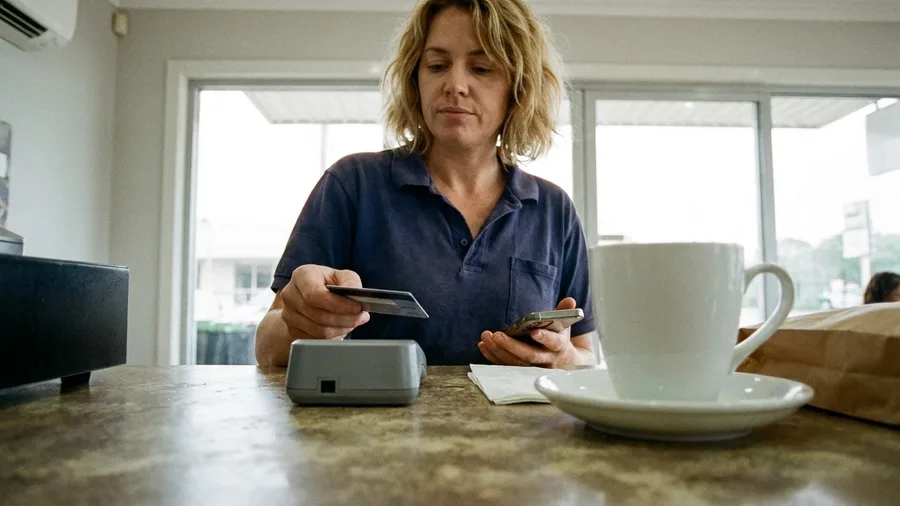
Route your spending money into its own account and turn overdraft off on it. That is the whole move, and it is the one that decides whether a normal week can reach bill money or not.
Mine gets $700 on the 1st and $650 on the 15th, which is $1,350 a month for groceries, gas and eating out. It is a no-fee online checking account, the same kind as my main one. And here is the cost nobody puts in the how-to: a separate spending pot is a second account to open, a second set of login credentials, and a debit card that is not the one already in your wallet. It takes an afternoon and about a week of reaching for the wrong card before it stops feeling strange.
The harder cost is the one you feel in month one. On the 27th I stood at a coffee shop counter and the card declined with $4.10 in the account and the next transfer four days out.
That was not a failure. That was the system working exactly as designed.
With overdraft switched off, the card declines at zero instead of quietly pulling from the bill transfer sitting in main checking. The alternative is worse in a way you do not see until later: an overdraft fee of roughly $35 per item if your bank still charges them, stacked on a bill you now cannot pay. I would rather be embarrassed at a register for ten seconds than short on rent.
The part that took me longest to accept is that the spending balance is now the only spending number in my life. Main checking is a $1,200 buffer plus money already assigned to something else, so looking at it tells me nothing useful about whether I can afford dinner out. The small number in the spending account tells me everything. The trade-off is real: I gave up the comfort of one big balance that felt like slack. What I got back was a card that physically cannot reach the rent – the edge is the account, not my willpower at 6 p.m. on a Tuesday.
Set the two transfers, switch overdraft off, and let the first decline happen. It will sting for a minute. Then it stops being a surprise and starts being information.
The money-map words, decoded
8. The Low-Balance Text Alert

Set one text alert on the account where your paycheck lands, low enough that it never fires during a normal month. Mine sits at $500, on top of a $1,200 cushion, so a ping in my pocket means roughly $700 has gone somewhere it shouldn't have. The bank offered a second threshold, so I put that at $250 too.
A schedule that failed to run is about the only thing that pushes the cushion down that far. Twice in eight months my phone lit up, both times because an expiring card on file made the bank pause a repeating transfer until I re-approved it. Each time I fixed it in the app in under a minute and no draft bounced. Even a single alert at $400 beats none; you can add the matching dollar figure later.
9. The Bill-Pay Date Map

A $48 insurance premium taught me more about bill timing than any spreadsheet. It drafted on the 28th, five days before the money for it existed, and the bank returned it with the fee attached. Today it drafts on the 12th.
The fix is one sheet of paper, or one note on your phone: every automatic payment, the amount, the day it comes out, lined up against the day the money for it arrives. My rent has drafted on the 1st since the start, the same morning the $2,900 lands in that account, and the remaining $1,240 of fixed bills is spread between the 5th and the 20th, all of it after the deposit.
Keep the last five days of every month empty. Between payments my bill account sits near $10 and has nothing to give. That's deliberate, and it means a bill pulled on the 28th will always fail, and that failure is the map telling you to move the date, not a money problem.
The arithmetic leaves $10 of room: $2,890 of outflows against $2,900 in. So the day a new bill shows up, whether it's a premium increase or a higher rent, the amount you fund goes up with it, same day.
🗺️ Build the map in six steps
Open the bill account
A no-fee online checking account funded with $2,900 on the 1st, with rent and fixed bills auto-paying from it.
Set the $1,200 buffer
Park $1,200 in main checking and never spend it; add a $500 text alert.
Split the spending account
$700 on the 1st and $650 on the 15th into a separate account with overdraft off.
Add savings
$600 on the 3rd into a separate no-fee online savings account with no linked card.
Add the sinking fund
$250 on the 15th, labeled for car repairs, holidays and annual bills.
Add the brokerage
$300 on the 10th into one broad index fund, on a repeating order you never skip.
10. The Renamed Account Labels

I opened the app on a Friday in month two, saw a balance I could not place, and pulled $300 out of a fund I had been feeding for weeks to cover a weekend trip. Nothing was broken. The account was just named "Savings" by the bank, so my own brain filed it as spare change.
The fix cost me one evening and no money: I renamed every account so the name holds the job, the amount and the date. The bill account now reads "BILLS-1st $2,900." The spending account reads "SPEND-1st $700 / 15th $650." The others follow the same shape – savings at $600 on the 3rd, the sinking fund at $250 on the 15th, the brokerage at $300 on the 10th.
Scroll the list and it reads top to bottom in the order the money moves. That name replaced the spreadsheet I was never going to open, and it means the setup keeps working in months I forget it exists.
11. The Quarterly Two-Minute Audit

The common belief is that a good automatic setup runs itself forever. Mine almost did not. Automation does not stay correct on its own, because the numbers behind it move whether you watch them or not.
Rent goes up. A premium renews at a new rate. A bank app update flips a setting you turned off on purpose. None of that sends you a notification, and the transfer amount you set in month one quietly stops matching the bills it is supposed to cover.
So I put one recurring calendar reminder every three months and check exactly three things. Did each scheduled transfer actually clear. Does the bill account still cover the full $2,890. Is overdraft still switched off on the spending account.
That is the whole audit. Two minutes, and the timer is honest – shorter than the wait at a grocery checkout. The bill total is the one that earns its keep: the funding number has to change the same day a rent increase or a new premium lands, and this check is where I catch it before it bounces.
Month three, the audit paid for itself. A bank app update had switched overdraft back on for the spending account. I caught it in the window before it mattered, turned it off, and moved on.
Between audits I leave the daily balances alone. No morning balance check, no app badge to clear. The $500 text alert on main checking is the exception handler, and it only fires when something is actually wrong.
Two audits done in eight months, both clean apart from that one toggle. The discipline is not watching the money. It is looking three times a year, at the three things that break silently.
12. The One-Page Money Map

The fear here is that writing it down means a binder, a filing system, another thing to maintain. It is six lines on one page, and you can type it in the time it takes to drink a coffee.
List the moves in the order they happen, with the account name from your app beside each one. Mine reads: $2,900 on the 1st from BILLS, $700 on the 1st from SPEND, $650 on the 15th from SPEND, $600 on the 3rd from SAVE, $250 on the 15th from SINK, $300 on the 10th from INVEST. The $1,350 spending allowance shows up as its two halves, because that is how it actually moves.
The account name on each line is the part that makes the page usable. The page and the phone use the same words, so anyone reading it can find the account without guessing. I keep it in the same note as the list of every bill autopay and the day it drafts, not in a folder of statements nobody opens.
I wrote it against one test: could my wife run the whole setup from this page alone if I were out of reach for a month. She could, which is the point.
That page is also what makes the map portable. A bank change, a partner taking over the bills, a new job with a different payday – the amounts get edited and the structure survives.
💡 Tip: Write the six dates and amounts on an index card and tape it inside a kitchen cabinet. If the phone dies, the plan survives.
Frequently Asked Questions
How much cash should I keep in checking as a buffer?
Enough to absorb a transfer posting a day or two late. On my $5,400 take-home, $1,200 works. A rough rule: cover your two biggest automatic withdrawals plus a few hundred. Start with $500 if $1,200 feels impossible.
Do I need a separate bill account, or can I just track it in a spreadsheet?
You can track it, but a separate account removes the decision. When bill money sits in the same account as groceries, it looks spendable. A separate no-fee checking account funded to the dollar makes it physically unavailable.
What if I don't have $1,200 for the buffer yet?
Use a simpler two-account version first: main checking plus the bill account. Skip savings, sinking and brokerage until the buffer is funded. Add one transfer at a time, one clean month apart.
Should I automate investing if I have credit card debt?
It depends on your interest rate and your cash cushion — this is one to run against your own numbers, ideally with a fee-only fiduciary. A common order is: minimums on all debt, a small emergency fund, then decide whether the card rate or the market is the better use of the next dollar.
What happens if a transfer fails?
The $500 text alert catches it. Most often a card on file expired and the bank paused the transfer. Fix it in the app, and the buffer covers the gap in the meantime.
Is it too late to start this if I'm in my forties?
No. The setup takes one afternoon and starts working the next payday. The point is not to catch up on years you missed — it's to make sure every dollar from here on has a job and is already promised or free.
Open the bill account first, then let one clean month pass
Open the bill account first, this week: a no-fee checking account, $2,900 scheduled out of main checking on the 1st, rent and fixed bills auto-paying from it. Then the spending split, $700 on the 1st and $650 on the 15th, overdraft off. Nothing else.
Wait one clean month before adding the $600 savings on the 3rd, the $250 sinking fund on the 15th and the $300 brokerage on the 10th. Five new transfers at once is how the first month breaks. If you don't have the $1,200 buffer yet, run the two-account version first: main checking plus the bill account, spending from main, the $500 alert on, until the buffer exists.
The 2 a.m. balance checks stopped once the number stopped being ambiguous. Rent was already gone, spending had its own pot, and what was left was mine. The panic was never about short money. Start with the bill account, and let the map do the remembering.