

The return is probably fine, you tell yourself, because every number on it came off a real form. Put that belief down before you sit.
The forms are right. The return built from them is where the errors live.
On the table: a 1099-R, an SSA-1099, a 1099-INT, a 1099-DIV, a brokerage statement, last year's return, and the IRA contribution records nobody kept in one folder. One question sits over all of it, which of these lines is most likely wrong.
Returns reviewed by the hundreds rarely fail on anything exotic. The same eight lines fail, in the same shape, return after return, and seven of the eight are visible without any tax software. Every one has the same anatomy: a form in the pile states an amount, the return assumes something different about it, and nobody compared the two before signing.
What follows is each error in the order it appears on the return, what it looks like when wrong, why it happens, and the first move to fix it, enough to review your own return or a parent's before it is filed.
Quick Tips Before You Start
Pull last year's return first
It answers two of the eight checks before you touch anything else.
Compare total tax to total withholding
One subtraction tells you whether a balance due is coming.
Match every 1099 to a line
If a form is in the pile and not on the return, find out why.
Call the custodian, not your memory
The IRA administrator can confirm the required amount in writing.
Keep the SSA-1099 with the return
That form never states a taxable figure; the return has to calculate it.
Withholding and income reporting
The first two mistakes sit on the income lines you meet earliest, and they share a root cause: each payer sends its own form and runs its own rules, so fixing one stream leaves the others untouched.
Check every 1099 source with a withholding election, not just the biggest one. That is where the balance due is hiding.
1. Withholding is set for a paycheck, not retirement

Start with the withholding line, before you look at anything else on the return, because it is the one line that explains why the April bill showed up at all when nothing about the year felt different.
Here is the pattern I see written out on page after page. A couple, both 67, total income $64,000 broken into $27,000 of Social Security, $15,000 from a pension, $18,000 in traditional IRA withdrawals and $4,000 of interest. The withholding election was active on the $15,000 pension. That was the only place any tax was being taken out. So $49,000 of income landed over the year with nothing prepaid against it, and the return produced a balance due that felt like a mistake and wasn't. The couple spent three weeks convinced someone had filed wrong. Nobody had. One box on one form was doing all the work, and it was too small for the job.
What makes this hard to catch is that each payer runs its own election in its own world.
The pension administrator has a withholding form. The Social Security Administration has a separate one. The IRA custodian has a third. Fix the biggest line, and the other two keep sending income untaxed because nobody touched them. It is genuinely not a willpower problem – it is four forms that have never been in the same room.
The first move takes twenty minutes at the table. Find last year's total tax line and compare it with this year's withholding to date, added up across every payer, and do it before the next income payment arrives rather than in April.
The IRS Tax Withholding Estimator gives you the target number to aim for. Then you go to each payer's own withholding form and set it there, one stream at a time, the pension and the Social Security and the IRA withdrawal each separately. The number that matters is the gap between what you owe and what is being taken out so far, and it is visible on paper right now.
💡 Tip: Check every 1099 source with a withholding election, not just the biggest one.
2. Social Security gets reported as tax-free

The myth runs like this: Social Security is the money you already paid for, so the government leaves it alone. So the SSA-1099 goes into the folder with the receipts and never reaches the income worksheet. Meanwhile the $27,000 of benefits sits next to $37,000 of pension, IRA and interest income, and the return reports the second figure as if the first did not exist. The tax is not zero. It was just never calculated.
Two shapes show up at the table. In one, the SSA-1099 is missing from the worksheet entirely, like a page stapled to the wrong stack. In the other, the $27,000 gets typed in as taxable income where the worksheet wants a produced number, and the return overstates by the same $27,000. Both come from the same gap: the SSA-1099 states no taxable amount anywhere on it. It reports benefits paid, full stop. That blank space is exactly why it slides out of sight, and why the return has to generate the figure from the whole picture.
take the SSA-1099 out of the folder and lay it on top of the return before anything else is touched, so the form is physically in front of you when the Social Security section is opened. Then run the IRS worksheet or the software's own section, keep the SSA-1099 clipped to the return, and let the arithmetic decide. There is no threshold to check against and no percentage to apply. The worksheet reads the full return and returns a number, and that number is the one that goes on the line.
⚠️ COMMON MISTAKE
The form that never states a number
The SSA-1099 shows gross benefits, not a taxable amount. If it is missing from your worksheet, the return has silently assumed zero.
3. Quarterly payments stop when the paycheck does

The move is to restart prepayment on the income that arrives without any tax taken out, either by adding withholding to a stream that already has an election or by sending quarterly payments on a schedule.
Consider the 68-year-old who retired from the payroll but not from the work: Social Security now lands every month, and $28,000 of consulting income arrives across the year with not one dollar withheld. For decades the employer quietly prepaid the tax before the check hit the account. That arrangement ended with the last paycheck, and no form replaced it. The account balance did not fall. What fell was the amount being sent ahead of the April bill, which is why the shortfall grows in a year when income looks smaller on paper.
Two levers exist, and pulling either one is enough. The first is withholding from a stream that already has a form: Social Security, the pension, or the traditional IRA withdrawals. The second is quarterly estimated payments, sized with the IRS Tax Withholding Estimator and paid on the IRS Form 1040-ES schedule, roughly every three months, with the first due in the spring. One path, both legal, different amounts of paperwork per year.
Where this does not apply: a retiree whose every income stream already carries withholding that covers the year's tax. That is a conclusion the numbers reach, not a feeling reached in January. Add the withholding shown across the 1099s, compare the total with last year's tax line, and the gap tells you which case you are in.
💡 Tip: If your consulting or part-time pay has no withholding, set up one estimated payment this quarter rather than waiting for April.
Withdrawals, basis and conversions
These three mistakes all live on the retirement account lines, where the return depends on records the custodian holds and the retiree rarely keeps in one place.
The common thread: the return assumes something about the account that the account's own paperwork would correct.
4. Required IRA withdrawals get missed or miscalculated

My father called me in November convinced he had the rule memorized. He had taken $14,000 from his traditional IRA back in February, and when I asked how he picked that number he said: it's just what the law says once you turn 72. He had a traditional account and a Roth, and in his mind the requirement applied to both, so he had split the difference himself.
The number most people distrust first is the one the account statement gets wrong. Memory says the rule is an age and a percentage; the custodian's own calculation says a specific dollar amount, figured from the balance on a specific date using the method the IRS worksheets spell out. Those two answers are rarely the same, and only one of them counts.
The shapes this takes are consistent. The withdrawal skipped entirely because nobody flagged the year. The math run off the previous year's December 31 balance instead of the required one. Or an inherited account treated as exempt because it was never the retiree's own IRA and the requirement attaches to the beneficiary instead.
Call the custodian before the year runs out and ask them to confirm the exact amount for each account in writing, so the number is on paper and not in a memory that has already proven unreliable. If a year has slipped by, the correction happens on the official form, not by pretending it did not happen.
Three ways the required withdrawal goes wrong
5. Nondeductible IRA basis is forgotten

The anger usually arrives at the kitchen table, not at the return preparer's desk: someone pulls an old statement showing a contribution the retiree remembers making, and the withdrawal was taxed as though none of it existed.
Start with the records, not a guess. Pull the old returns, Form 5498 from the custodian and any decades-old statements, then rebuild the total nondeductible amount and file Form 8606 to put that figure on the return. A retiree who made $12,000 of nondeductible contributions in the 1990s has paid tax on that money going in; withholding it from the basis count means paying a second time on the way out, and the tax hits again on every withdrawal until the basis is recorded.
Look for a 5498 or a prior return showing nondeductible contributions; if the custodian's files show none, the question is answered without a guess.
The Same $25,000 Conversion, Three Ways
Retiree, age 72: $310,000 traditional IRA, $85,000 Roth IRA, one $25,000 conversion during the year
6. Roth conversions vanish from the return

$25,000 moved from a traditional IRA into a Roth in a single quiet transaction, and four months later a 1099-R lands in the mailbox reporting exactly that amount as a distribution. The instinct is to read it as a taxable withdrawal, and the return then either reports nothing as income or reports the whole $310,000 traditional balance instead of the $25,000 actually converted.
A conversion is not a withdrawal, and the form that makes the distinction is Form 8606. The $25,000 has to land there as well as on the 1040 line, and the reason is not bureaucratic tidiness: the five-year clock on the Roth starts from the conversion and is traced off that form. Leave it blank this year and there is nothing on paper to point to later.
Before signing, match the 1099-R, the conversion paperwork and the Form 8606 entries against each other; if all three agree, the line is finished. This is the mirror of a basis problem, where money had already been taxed going in and the records have to prove it.
Direct contributions to a Roth are a different animal. No 1099-R for a conversion means no conversion line, and the return is right to stay quiet.
💡 Tip: The 1099-R and the Form 8606 should show the same dollar amount. If they don't, stop and reconcile.
Refunds and state moves
7. State tax refunds get double-counted
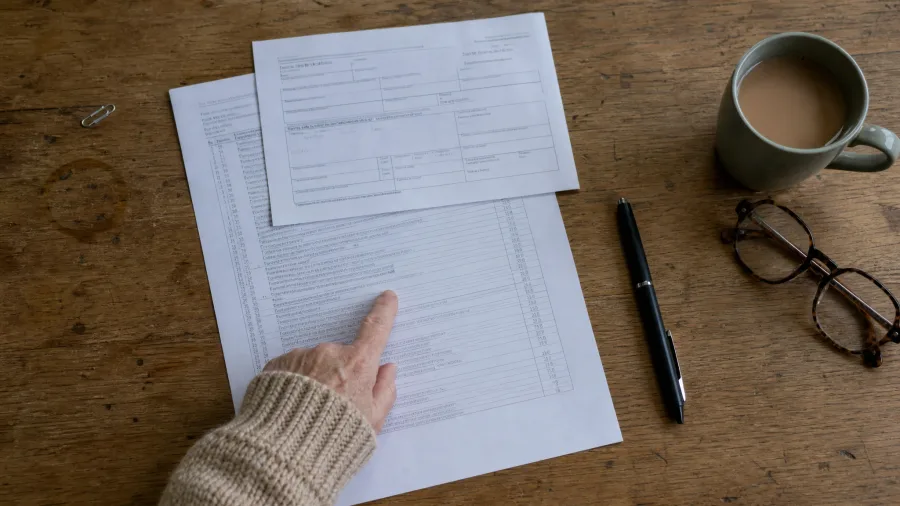
It depends on what the prior-year return did, and the 1099-G will not tell you. The $9,800 California refund arrives as a form stating an amount, and the form assumes nothing – so the return either reports the whole thing as income or leaves it off. The answer sits on last year's Schedule A: whether state income tax was actually deducted, and how much federal benefit that deduction actually produced.
That is the comparison: the 1099-G against the prior-year return. This is the kind of question where your own numbers decide it, and where a CPA earns the fee – the refund is taxable only to the extent the earlier deduction lowered your federal tax, and the only document that shows that is the Schedule A you filed a year ago. Pull it before you trust any rule of thumb about refunds, including a confident one from a sibling at the table.
And if the prior-year return shows no state income tax deduction, the 1099-G still lands in the mailbox and the income line stays empty.
What the Refund Form Does and Doesn't Tell You
The 1099-G tells you
- Box 1 amount: $9,800
- Box 2: the tax year of the refund
- That California already paid it out
The prior-year return tells you
- Schedule A line 5a: state tax deducted, or blank
- Line 5e: the federal benefit that produced
- If 5a is blank, leave the refund off and stop
Refunds and state moves
Everything on this list up to now gets settled by looking at the current year's forms. A state tax refund can't be, and that catches people off guard: the 1099-G showing $9,800 of California money lands in the pile, the number looks like income, and around it goes.
Whether it belongs on the return depends on a deduction taken two Aprils ago. If state income tax was itemized on last year's Schedule A, that deduction reduced federal tax, and the refund is the government handing back a benefit already received. Report it. If the standard deduction was taken instead, no benefit was ever received, and the $9,800 is not income to anyone.
The two ways this line breaks are opposites. Sometimes the whole refund gets entered as taxable income even though the standard deduction was taken, which means paying tax on money the return already treated as untaxed. Sometimes it gets left off, because a refund feels like a return of your own cash rather than reported income, while the prior-year deduction quietly lowered the bill. Both come from the same place: a guess about refunds in general instead of a look at the actual prior-year form.
So pull last year's Schedule A before touching the 1099-G. The two documents together answer the question; either one alone invites a wrong answer.
Retirees who took the standard deduction last year can leave that income line blank even though a 1099-G still shows up in the mailbox. The form's presence is not the trigger. The deduction is.
For the adult child helping a parent file, this is the reason to dig out the prior-year return first rather than last. It is the only paper at the table that settles the question, and it is usually the one buried at the bottom of the folder.
8. The old state's return is skipped after a move

Two state returns is not a sign you did something wrong. It is the ordinary arithmetic of changing your address mid-year, and it is the most mechanical item in the pile once you set it up correctly.
Take the example: a 66-year-old who moved from California to Arizona in July and kept the same brokerage account at the same custodian. Pre-move California income and post-move Arizona income are two separate filing questions, not one address change. The brokerage does not split itself; the account keeps generating income before and after the move, and the return has to say which state gets to tax which part.
The three wrong shapes are predictable. Filing only in Arizona. Ignoring California-source income after the move. Or splitting every income item 50/50 across the two states by months instead of by dates and by source – which looks tidy and is not how the forms work.
Date, Income item, Source. Go down every 1099 and every brokerage statement line by line and sort each item by the date it was paid and the state it came from, not by which half of the year it fell in. Dividend paid in March from the old account: California, January through July. Interest paid in October: Arizona, if the payer is in Arizona. Social Security paid all twelve months: it goes where the rules for that income say, and the instructions tell you which column it lands in.
Then get the part-year resident form from each state's revenue department – California's and Arizona's, in this example – and read the instructions for each income type, because the forms differ by state and by what the income is. The sheet feeds both returns. Every line on it is traceable to a 1099 and to a date.
This does not apply to you if you moved after the tax year ended, or if all your income comes from a single state. In those cases one return, one set of forms.
One honest reservation: two state returns mean two sets of forms, two sets of instructions and two filing dates, and the part-year rules are the least forgiving part of the pile. If the merged totals and the source columns do not reconcile to the W-2s, 1099s and the Social Security statement, stop and get a preparer who does multi-state returns for a living. The sheet you built is what they will ask for, and having it ready is most of the work.
💡 Tip: The brokerage account that moved with you still generates income in the old state until the move date. Split by dates, not by halves.
Your Pre-Filing Review Week
Frequently Asked Questions
Why do I owe so much now that I'm retired?
Because withholding is set per payer, and it usually stays on the paycheck that stopped. If your pension carries the only election, your IRA withdrawals and Social Security may arrive with nothing prepaid all year. Compare last year's total tax with this year's withholding before April, using the IRS Tax Withholding Estimator to set a target.
Do I really have to pay tax on Social Security?
Sometimes. The taxable share depends on your whole return, not the benefit alone — pension, IRA withdrawals and interest all feed into the worksheet. The SSA-1099 never states a taxable figure, so run the IRS worksheet or the software's Social Security section rather than assuming zero.
How do I know if I took the right required amount from my IRA?
Ask the custodian. Use the IRS required minimum distribution worksheets and the custodian's own calculation rather than a remembered percentage. If you have more than one retirement account, including an inherited one, confirm which accounts actually carry the requirement before year-end.
Should I pay off debt or save first?
This one genuinely depends on your numbers: the interest rate on the debt, your cash cushion and your income stability. A small emergency fund first is the usual starting point, but if the debt carries a high rate, run the comparison against your own budget or with a fee-only fiduciary before deciding.
Do I have to file two state returns the year I move?
Often yes. Pre-move income in the old state and post-move income in the new one are separate filing questions. Use each state's part-year resident form and split income by dates and by source, not 50/50. The California and Arizona revenue departments publish the forms and instructions.
The first mismatch is the one to fix before you sign
Pull three things onto the table: last year's return, this year's stack of 1099s, and your IRA contribution records. Check withholding and Social Security first, because those two change the size of the balance due. Then move to required withdrawals, basis, Roth conversions, the state refund and the state move.
You do not have to fix everything tonight. Fix the first mismatch you find, write down why it happened, and put the corrected form back in the pile. That one correction is the difference between a return that assumes and a return that knows.
Start with the 1099s and last year's return
Put them side by side tonight and check the withholding line against last year's total tax. If the gap is there, the fix starts with one phone call.