

In the cafeteria line at the hospital, everyone else's retirement number seemed to have a comma in a good spot. Mine was a spreadsheet with three years of deposits and no proof any of it was working. I was 41, an operations manager in Columbus, and a promotion had just pushed my take-home to $5,400 a month.
So I did something that looked reckless: $2,000 into one index fund every month for 36 months, then nothing.
Seventeen months after I stopped, the March 2009 statement sat on the kitchen table in Clintonville at $58,000. It had been $94,000. I was 46, adding nothing, and the loss was completely real. But every dollar of that money had gone in between 2003 and 2005, so every dollar still had 23-plus years of market ahead of it before I needed a cent. The count was never the point.
$72,000 in 36 months at 41 became $412,000 at 66. $340,000 of that was never my money. The calendar did most of it. By the end you'll know whether your window is short enough to front-load or long enough that steady paychecks win, and the one number to automate this week.
| What it compares | Front-loaded: $72,000 in 36 months (what I did) | Steady: $2,000 a month for 25 years |
|---|---|---|
| Total contributed | $72,000 | $600,000 |
| Years of compounding per dollar | 23 to 25 | 1 to 25 |
| Balance at age 66 in 2028 | $412,000 | ~$1,700,000 |
| Growth as a share of the final balance | 82% | ~65% |
| Cash flow freed after 36 months | $2,000 a month | $0 |
Front-Loading Worked Because the Money Went In Early

Front-loading meant thirty-six transfers of $2,000, and every one of them bought a different amount of time.
The first left my checking account on January 5, 2003, five days after my 41st birthday, and it had until 2028 to sit there. The last went out December 5, 2005, at 43, and it still had 23 years. It came out on the 5th like clockwork, pulled from a take-home check of $5,400, and the day after each one I opened the same statement, saw a bigger number, and closed it.
I want to be honest about where the $2,000 came from. It wasn't discipline I'd always had. It was a 2003 promotion to operations manager stacked on a car payment that died in 2002 when the 1998 Corolla finally got paid off. I knew that slack would close again, so I treated it as temporary money with a hard reuse date, not a habit I could count on forever.
What three years bought was not a purchase price but a running clock on every dollar. A share bought in 2004 out to 2028 is 24 years of whatever the market did, and I couldn't tell you a single choice I made in 2004 that came close to mattering as much as that.
Three Things I Got Wrong (or Nearly Did)
The Sacrifice Had an End Date After 36 Months
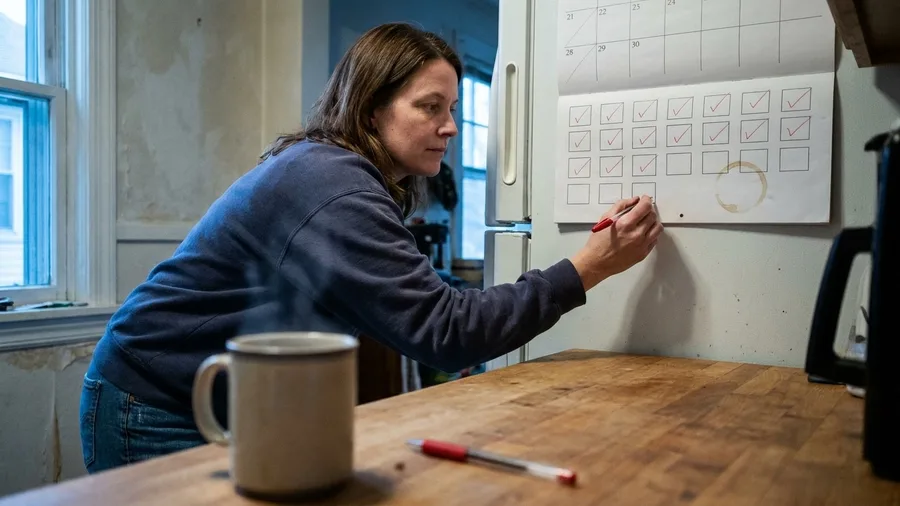
The sacrifice only worked because it had an end date: 36 months, written on the calendar in ink. Take-home was $5,400, $2,000 went to the fund, and the household lived on $3,400 in Columbus, the same $3,400 we lived on before the raise. The promotion did not change our life. It changed where the difference went.
I can name the things we didn't do. The new car we didn't buy; I drove that corolla until 2010. The Outer Banks trips we skipped in 2004 and 2005, and the bigger house in Worthington we drove past twice in spring 2004 and never asked about again.
The part that held it together was written in December 2005, a row of 36 small boxes on the kitchen calendar, one to tick off after each transfer. The last box got ticked on December 5, 2005.
And the month after was the proof it wasn't a personality. January 2006, the same $2,000 got redirected to mortgage prepayment and childcare, we went out to dinner once, and nothing else in the budget moved. The cost was capped at 36 months. A calendar, not a temperament.
One Index Fund Meant No Decisions After 2005

I bought one thing: a three-fund index portfolio style total-market index fund with a 0.05% expense ratio, and I never added a second fund, a stock pick, or a sector bet to it.
Keeping it that plain was the point of stopping after 2005. An account with one holding and no advisor has nothing to check, so a bad March gives you nothing to act on.
The monthly $2,000 was split by tax treatment. The Roth IRA took as much as the annual contribution limit allowed, because that money comes out tax-free after 59 and a half, which is exactly where I expected to be when it mattered. Everything over the limit went to a plain taxable brokerage account, and I left it reachable on purpose in case the mortgage prepayment plan ever fell apart.
No rebalancing. No fund swaps. No advisor fees after 2005. The choosing was done in three years and the next 23 asked nothing of me.
The arithmetic is the part most people skip. At 0.05%, a $412,000 balance costs about $206 a year. At 1%, the same balance runs about $4,120 a year, skimmed every year on the way up, in good markets and bad.
The Front-Load at a Glance
The numbers behind the three-year sprint
The 2008 Crash Cut $94,000 Down to $58,000

The envelope from the fund company landed in March 2009 and the number on it was $58,000. Seventeen months earlier, the October 2007 statement had read $94,000. That is a 38% drop, and I was 46 years old with no new money going in since the last transfer in December 2005.
Here is the part that actually stung, and it took me a while to name it. A friend of mine was still contributing every payday through that stretch, so his 2009 dollars bought shares at half price. Mine did nothing of the kind. I already owned every share I was going to own, and recovery had to come from lifting those, not from buying more of them cheap.
For three days I kept the fund company's 800 number on a sticky note by the phone, next to a transfer-to-cash form I had downloaded and half filled out. I dialed it once. It rang twice and I put the receiver down.
What ended it was my wife, standing in the kitchen doorway, asking a plain question: once the money was safe, what was I going to do with it? I did not have an answer. All I had was a date on a card in the file folder, 2028, and no plan that made sense before it.
So the account took the hit and I did not touch it. The crash changed the balance. It never changed the count, and the count was set back in 2003 and 2004 by the dates the deposits went in.
⚠️ COMMON MISTAKE
The mistake I almost made twice
Both times I nearly sold, the trigger was the same: a statement showing a number I didn't like and a phone in my hand. The fix that worked was a single line on an index card in the file folder: 'The money is not needed until 2028.' Keep one sentence like that taped where you'd make the call.
Nineteen Years of Doing Nothing Beat Every Trade

I never bought or sold a single share between January 2006 and 2028. Dividends got reinvested on their own, and my entire routine was opening the statement twice a year, on the 5th of January and the 5th of July. That was it.
Two moments came close to ending that. The first was March 2009, the $58,000 statement, with the cash-transfer form sitting half-filled on the desk. The second was March 2020, when I was working 60-hour weeks in a Columbus hospital and would come off a night shift and see the index futures on my phone at 3 a.m., bleeding red.
The same card stopped me both times. It lives in the file folder and it says one thing: the money is not needed until 2028. In 2009 I read it and closed the laptop. In 2020 I did not even read it, because there was no hour between shifts in which to do anything at all, so the account got nothing from me but time.
Activity has a price, and it is bigger than people think. An advisor taking 2% a year instead of the 0.05% I paid leaves roughly $260,000 at the end instead of $412,000. Sell the whole $58,000 in March 2009 and buy back in a year later 25% higher, and you leave about $55,000 of the final balance on the table.
After 2005 the only decision left in that account was whether to undo it.
Growth Made Up 82% of the Final Balance
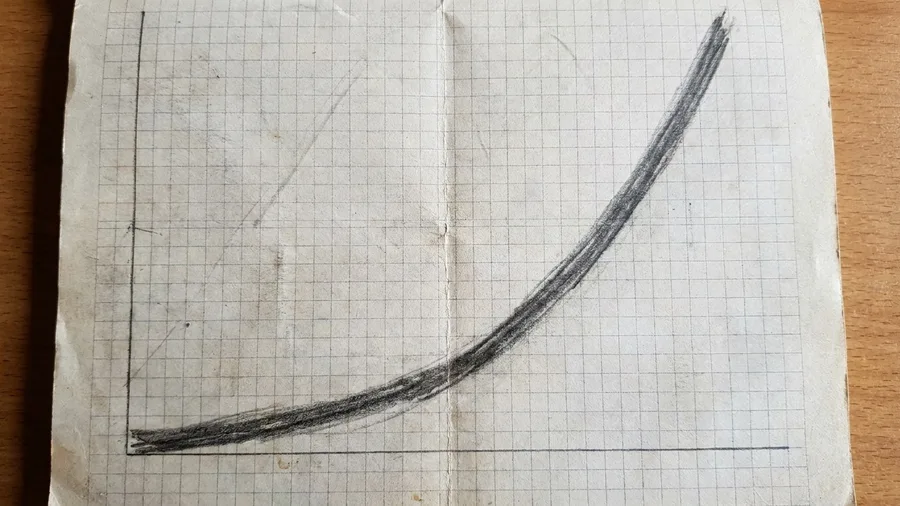
Almost none of the $412,000 is money I put in. I contributed $72,000 across those 36 deposits and $340,000 of the balance is growth, which works out to 82 cents of every dollar in the account being something that was never on a paycheck.
It did not arrive in a straight line. In March 2009 I was at $58,000. By the start of 2020 I had climbed to about $210,000. The rest, roughly $200,000 of the $340,000, showed up in the last eight years before 2028.
The early stretch gave me nothing to look at. By October 2007 I had $72,000 in and maybe $22,000 of growth, and at the five-year mark I was under water on what I had contributed. For a long time opening that envelope felt like reading a grade I had failed.
That is the shape of this thing for anyone doing it: the payoff is back-loaded and invisible for roughly a decade, which is exactly why the deposit has to run on its own and why the plan has to be boring enough to survive the flat years.
My deposits stopped in 2005. The calendar kept paying, and the last eight years out-earned the first eighteen.
The Jargon Behind My 25 Years, Decoded
The 25-Year Result: $412,000 at Age 66

The total is $412,000 at 66, and $340,000 of that is the market's money, not mine. On $72,000 in deposits, that is a gain of about 7.4% a year across the 25 years I sat still. A decent return, not a spectacular one, and the number I tape to the inside of a kitchen cupboard is not the balance.
The catch is what the figure leaves out, and the honest answer is that $412,000 is a balance, not a spending plan. I've still paid taxes on the taxable-account slice of dividends and growth along the way; the Roth half is tax-free. And a balance gives you nothing about timing — a life does.
At 4% a year, my own arithmetic gives about $16,500 on top of Social Security. Real money, but a supplement, not a replacement.
Which is why I'm writing this at 66 still clocking two days a week at the hospital. The health coverage is part of it, and the $16,500 gap is the rest. The account made the work optional instead of forced. It did not make it finished.
Three years of dates did that. The dates set the size of the pile; the pile is what changed what I could say yes to.
When Front-Loading Beats Steady Deposits — And When It Doesn't
Front-load if…
- A windfall just landed: bonus, buyout, practice sale, inheritance.
- Your earning window has an end date in sight.
- You have 20+ years before you need a dollar of it.
- You can automate it and then leave it alone for a decade.
Go steady if…
- You have a long run of paychecks ahead — 20 years or more.
- No lump sum is coming, just a monthly salary.
- You'd have to raid the account to make the next deposit.
- You're not sure you can hold through the first real crash.
Steady Paying-In Would Have Beaten Front-Loading by $1.3M

The comparison that actually stings is not against zero. It is against the same $2,000 a month, at the same 7.4% return, put in by someone whose paycheck kept arriving through 2028 instead of stopping in December 2005. Twenty-five unbroken years of $2,000 deposits lands somewhere near $1.7 million. My 36 months landed at $412,000.
So the gap is about $1.3 million, and I want to be honest about what filled it. From January 2006 the $2,000 went to mortgage prepayment and childcare, and the mortgage was gone in 2019. That was worth something real. It was not worth $1.3 million, and I knew it by the time the last payment cleared.
Here is where the honest comparison gets a small asterisk. Front-loading is only a thing when the money coming later is not guaranteed to come at all — the bonus, the buyout, the sale, the stretch of years you can see ending. If you are 42, salaried, and stable, the better move is to copy my 2003 to 2005 and then keep the deposit running instead of copying my 2006.
⏪ What I'd Do If I Could Rewind to January 2006
Keep the transfer date
Same automatic pull on the 5th of the month — don't cancel the link.
Cut the amount, not the habit
Drop $2,000 to $250 a month, which would have added about $165,000 by 2028.
Direct the freed $1,750
Send it to the mortgage and childcare, same as I did, without ever zeroing the deposit.
Raise it when the year turns
Every January, look at the pay raise and bump the deposit by half of it.
Open the statement twice a year
January 5 and July 5, and leave the phone alone in between.
I'd Slow Down Instead of Stopping at 44

If I could go back and change one thing, it is not the buying. It is the stopping. I stopped dead on the 5th of December 2005, and dropping the deposit to $250 a month starting January 2006 — one-eighth of what had been going out — would have added roughly $165,000 more by 2028. That is $412,000 becoming about $577,000, from a smaller amount than most people's car payment.
Stopping felt logical at the time, which is why it lasted. The promotion money was already spoken for, childcare invoices were months away, and the mortgage prepayment was a saving I could feel guaranteed. And in my head $2,000 was the only number that counted — anything smaller looked like a gesture, not a plan.
What I missed is that a 2006 deposit had 22 more years to run, and at my rate 22 years is most of the result. The rule I would hand anyone now is simple: never let the automatic transfer reach zero. In a tight year you set it to $250, keep it on the same date, and raise it back when the year turns.
Frequently Asked Questions
Is front-loading investing in your 40s better than steady monthly deposits?
Steady deposits won in my own case: the same $2,000 a month for 25 years beat $72,000 crammed into three years by roughly $1.3 million. Front-loading only wins when the later money never arrives — a bonus, a buyout, or an earning window that closes.
How much did $72,000 grow in 25 years?
It became $412,000 by 2028, about $340,000 of growth on $72,000, or roughly 7.4% a year. That includes the 2008 crash, which took my balance from $94,000 to $58,000, and the 2020 dip. The return isn't guaranteed and depends on the fund and the dates.
Should I stop contributing once my investment account hits a target balance?
No. Stopping in January 2006 was my one expensive mistake. A $250 monthly deposit from 2006 would have added about $165,000 by 2028. Cut the amount in a tight year but keep the transfer date and the account open.
What should I do with a lump sum if I'm in my 40s?
If you have 20-plus years before you need the money, invest it in a low-cost total-market index fund and leave it alone. If the lump sum is replaceable by future paychecks, spread it over monthly deposits instead. For anything tied to a pension, tax bracket, or a specific account choice, run the numbers with a fee-only fiduciary.
How do I keep from selling during a crash?
Write one sentence on an index card — the date you actually need the money — and put it where you'd make the call. Then check your statements twice a year instead of daily. In March 2009 I had the transfer form half-filled and hung up because I couldn't answer what I'd do with the cash if I sold.
The Deposit Date Decides More Than the Amount
Here's the rule I'd hand you. Earning window short, or a lump sum landed with 20-plus years to sit? Front-load it into one low-cost index fund over 36 months. Long run of paychecks ahead? Go steady, because 20-plus years of steady income beats cramming every time.
Then do one thing: pick a monthly amount you can genuinely hold for 36 months and automate it from checking before the next payday. Even $50 counts. The date on the deposit does the work, not the size.
That March 2009 statement is still in my file folder, $58,000, next to a card that reads the money is not needed until 2028. Nothing in my $412,000 came from a smart pick or a good year. It was 36 dates on a calendar, and I never moved one.