

The car insurance renewal landed in my inbox at 6:58 on a Saturday morning, and I opened it with my coffee still too hot to drink. $142 a month, up from $119 two years ago, for a policy I had never once questioned.
For about a year I told myself the same thing: internet, phone, insurance, the gym, that $12 bank fee – they creep up, sure, but calling means hold music, and hold music is a wasted weekend. I am 34, I work in marketing in Columbus, Ohio, and I rent a two-bedroom house. My evenings belong to my family, not to a billing department.
Then I did the weekend anyway. Saturday 8:30 a.m. to Sunday 4:15 p.m., nine calls, about 6 hours 15 minutes on the phone. One legal pad, a folder of bills and policies, two competitor quotes open in browser tabs, and a rule: I would not accept the first number offered. The longest hold was 38 minutes with the car insurer.
The total was $175 a month, $2,100 a year. But seven of the nine were rate changes and two were downgrades. Three ended with a firm "that's the best I can do" before a callback landed, and two needed a second attempt the next morning.
the weekend pays only when each call targets a real lever – a cancellation desk, a contract end date, a plan switch, a coverage change, an annual rate – not when it asks for loyalty. By Monday you will know which bill to call first, which two are not worth the hold time, and the one opening line that works. The rest can wait a paycheck or three.
What Each Call Actually Costs You
The two that need a second morning
Gym and live TV only moved on attempt two. Budget a callback slot for both instead of writing them off after the first no.
Cheapest wins per minute
Security monitoring fell $15 and renters insurance $7 in under ten minutes each. Do those two first while the coffee is still hot.
Two of mine were downgrades, not discounts
Gym $29 to $10 and live TV $65 to $39 meant giving something up. Decide what you will actually live without before you dial.
The $11 that was not a negotiation
Half the car insurance saving came from moving my deductible from $500 to $1,000. That is a risk trade, not a win. Ask what yours costs.
Skip any bill without a lever
No contract end date, no competitor quote, no plan to switch? You are spending hold time for a scripted no. Leave it for next quarter.
Phone, internet and TV: where retention desks actually have money
These three bills are the ones people mean when they say they should call and complain. They are also the three where the leverage is real: a cancellation desk, a contract end date, and a competitor's price are all things a rep can act on.
The catch is that the person who answers billing is not the person who can save your account. You need the cancellation department, and you need to be genuinely willing to cancel.
1. Internet: the cancellation desk beat the loyalty desk

Saturday morning I had two browser tabs open, one a competitor's internet price, and I called billing first. The rep told me, flatly, that no retention plan existed. I asked to be transferred to the cancellations desk, and the same company offered me a plan that had apparently materialized in the last four minutes.
Cancellations desk is the lever, and it only works if the other side can hear you walk. My bill went from $84.99 to $54.99, $30 a month, $360 a year, on a 12-month term. A billing rep has no cancellation budget; the desk that loses customers when they leave does.
Set this up before you dial: out of contract, competitor's monthly price written down, and your account number on the legal pad. If you're still inside a contract, the early-termination fee eats the whole threat before the retention plan can show up. And the $30 came with a speed drop, 500 Mbps to 300, which for two people streaming and taking work calls was invisible. Automation here is the calendar reminder: check the contract end date, and call that week.
💡 Tip: Ask for the cancellation department by name. Do not explain your problem to billing first, because they will log the call and the next rep will see it.
| Bill | Before, per month | After, per month | Saved per year |
|---|---|---|---|
| Internet | $84.99 | $54.99 | $360 |
| Cell (3 lines) | $145 | $110 | $420 |
| Car insurance | $142 | $120 | $264 |
| Renters insurance | $19 | $12 | $84 |
| Security monitoring | $44 | $29 | $180 |
| Gym | $29 | $10 | $228 |
| Live TV | $65 | $39 | $312 |
| Bank maintenance fee | $12 | $0 | $144 |
| Subscriptions | $14 | $5 | $108 |
| Total | $554.99 | $379.99 | $2,100 |
2. Cell: leaving postpaid for prepaid was the whole win

The common belief is that you call your carrier, threaten to leave, and a retention rep finds you money. I called. No offer came anywhere close.
What moved the $145 to $110 was switching three lines to a prepaid plan on the same network, $35 a month, $420 a year. Prepaid dropped the device subsidies and the international roaming. That matters only if you use them: I own all three phones outright and had no trip booked, so nobody on my plan lost a thing. Do the same inventory before you switch, because if you're still paying off a phone on an installment plan, the early payoff or the lost subsidy can erase the $35.
Copy the routine: write down the account number and PIN before you dial, or the port stalls at the worst moment. One line, one plan, one bill.
💡 Tip: If you are still paying off a phone on an installment plan, stay put. The early payoff or lost subsidy can erase the entire $35 a month.
📞 The weekend, hour by hour
Saturday 8:30 a.m.
Internet: billing says no, cancellations says $54.99.
Saturday 9:15 a.m.
Cell: prepaid switch, port the three lines.
Saturday 10:40 a.m.
Live TV: decline the $10 off, cancel the tier.
Saturday 1:00 p.m.
Car insurance: 38-minute hold, deductible and quote.
Saturday 3:30 p.m.
Renters insurance: one quote, 20 minutes.
Sunday 9:00 a.m.
Security, gym, bank fee, subscriptions: the fast calls.
Sunday 4:15 p.m.
Last call ends. Total: $175 a month, $2,100 a year.
3. Live TV: the only real lever was dropping it

Two retention reps offered me $10 off live TV, and both times the bill would have landed at $55 a month. It felt like a win, and it was not. Haggling the package got me exactly $10 no matter who I talked to.
The ceiling on the retention script was built into the product. The same cancellation threat that works elsewhere had nothing to grab here, because the reps had no room past that ten-dollar mark. Dropping the live tier entirely and keeping the two streaming services I already watched, Netflix and Hulu, took the line from $65 to $39. That is $26 a month, $312 a year, and more than double what the nicest rep could authorize.
What I gave up is real. No live channel surfing, no bundled sports, and this season that means Columbus Crew matches and MLB games I actually followed. I am planning to come back for the NFL playoffs in January, so the cut is not permanent, just a gap I chose.
This one is where you stop calling and look at what your own household actually watches. Nobody at the provider can tell you whether $26 is worth losing your team. Sit with your own viewing for a week, count what you would genuinely miss, and if it is one sport for one season, cut the tier instead of taking the discount. If you are mid-promo on a bundled two-year deal, skip it entirely – an early termination or promo clawback can wipe out the $26 before you have saved it once.
Live TV – The Numbers the Rep Won't Give You
📉 Retention ceiling
$10 off, every rep, no exceptions
⏱️ Break-even on the cut
One month. $26 recovers the $39 in 1.5 months
🏟️ Cheapest sports re-entry
Re-add the tier for one month only – roughly $39, not a season pass
⚠️ Promo clawback risk
Check the contract end date before you dial – a $26 cut can trigger a $100+ recovery fee
📝 Watch-first test
One week, one page: list every live event you'd pay $26 to keep
The honest math
A $10 discount is the provider's ceiling, not yours. Your real number is $26 a month – and it only exists if the streaming you already pay for covers what you actually watch. Count the games before you call.
Insurance and the house: coverage terms, not charm
These calls are different from the first three. There is no cancellation desk with a secret budget. The lever is your coverage, your deductible, or a competitor's quote, and the trade is risk you are agreeing to carry yourself.
That means the savings are real but smaller, and you should not make these calls until you have cash set aside for the thing you are now covering.
4. Car insurance: raising the deductible beat shopping around

The thought that kept me on hold for 38 minutes was that switching insurers would be a nightmare of paperwork, and changing my coverage felt like gambling with my own safety.
So I did both, in smaller doses than I expected. Two online quotes took about 20 minutes total. Then I made one call to my own insurer, sat through the weekend's longest hold, and ended up at $120 a month from $142 – $22 saved, $264 a year, split almost exactly down the middle. Eleven dollars came from moving my deductible from $500 to $1,000. The other $11 came from the cheaper of the two quotes.
Here is what that $11 actually buys and costs. If I file a claim now, I need $1,000 in cash before the insurer pays anything. I have that $1,000 sitting in an emergency savings account I don't touch, so the risk was funded before I took it. If it weren't, this would have been a bad trade dressed up as a saving.
There was no retention script here, no loyalty desk, nobody to charm. Coverage change did half the work and shopping did the other half, which is the thing I had wrong going in – I assumed the only phone call that mattered was the one where I threatened to leave. It wasn't. It was two quotes and one honest look at my own savings.
💡 Tip: Get two online quotes before you call your own insurer. The quote is what makes the rep take you seriously, and it takes less time than the hold.
⚠️ COMMON MISTAKE
One mistake that costs the whole weekend
Do not raise a deductible until the cash is sitting in a separate savings account. A $1,000 deductible with $200 in savings is not a discount, it is a loan you are taking from yourself at the worst possible moment.
5. Renters insurance: twenty minutes for seven dollars

Pull up one renters insurance quote before you decide this bill is too small to bother with.
The renters policy was the smallest line on my legal pad and the fastest call of the weekend. Nineteen dollars a month went to $12 – $7 saved, $84 a year, the least impressive number I wrote down. Total time, quote to confirmation email in my inbox, was about 20 minutes. One quote, one call, done by mid-morning Saturday.
Why bother for $7? Because in two years my premium had gone up twice and I had never filed a claim. With a clean claim history, shopping is the only lever you have – there's no retention desk waiting to reward you for staying. A competitor's number does the arguing for you, and on a small policy it takes one call instead of a negotiation.
The catch was coverage. My personal property limit dropped from $30,000 to $20,000 when I moved to the cheaper policy, and I had to actually think about what my stuff is worth before I accepted that. If your possessions run past $20,000, keep the old policy – the $84 isn't worth being underinsured.
This is the one worth doing first if you're staring at a list of bills and feeling like it's too much. Seven dollars a month sounds like nothing. But it's 20 minutes, it's one quote, and it proves the whole thing works before you spend a weekend on the bigger calls.
Scale it down further if you need to. Get the quote today and make the call next week. Small and consistent still beats the version of this you keep meaning to get to.
6. Security monitoring: an expired contract is the leverage
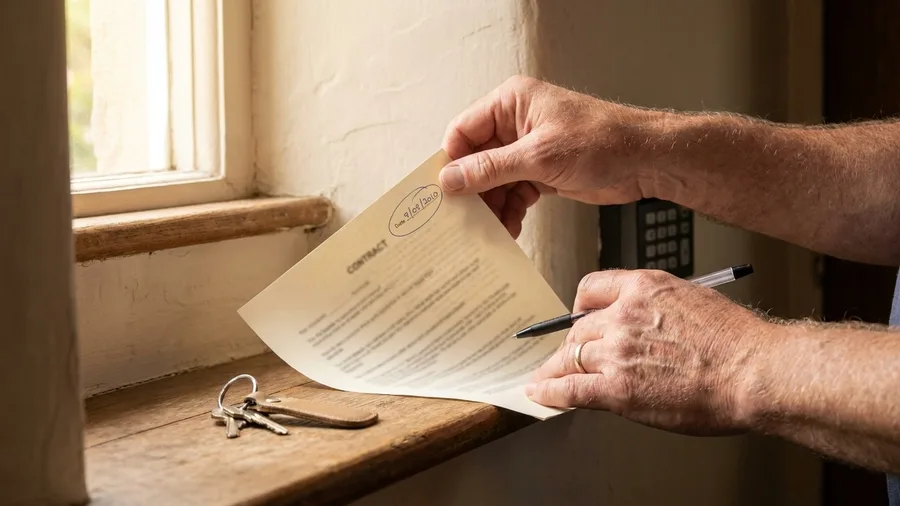
The move is to look at your contract end date before you look at anything else.
A small policy like renters insurance can be repriced in one call, but the alarm contract runs on a different clock. My security monitoring was $44 a month for years, and the multi-year agreement had quietly expired without me noticing. Once it had, the same company offered me a loyalty rate of $29 a month – $15 saved, $180 a year – that it had never once mentioned while I was locked in.
So if you're mid-contract with years left, skip this call entirely. That's allowed. The offer only showed up after the end date passed, and an early exit can cost more than the $15 a month you'd save, which means you'd be paying to leave and losing money to do it.
The other thing to know: the company owns the panel. Leaving after the contract means returning the equipment and losing the monitoring service, not writing a penalty check. That's a real inconvenience, not a trap.
If your end date is within a few months, put a note on the calendar and wait for it. Ask then, not now. Patience is the whole discount here.
💡 Tip: Find the end date on your alarm contract before you dial. If it is within 90 days, wait for it and call the week after.
Fees, memberships and subscriptions: the only lever is a different product
These are the bills with no retention desk and no budget for a discount. The rep on the phone cannot waive the fee or cut the membership. The only move is switching to a different product, or canceling entirely.
That is why they are last in the weekend. They take the least time and the least courage, but they require you to give something up.
7. Gym: the front desk had no retention offer

Not the way you negotiate a phone bill. There is no retention budget at the front desk, no manager authorized to shave dollars off to keep you, and no discount code hiding behind a polite ask. What there is instead is a cheaper tier of the same gym, and a decision about whether that tier fits how you actually use the place.
My membership ran $29 a month. I walked in on a Sunday expecting the usual dance, and the person at the desk told me plainly that their only two options were freeze or cancel. No one there could discount. That is not a brush-off; it is the structure of how most gyms price. Monthly dues are the product, and the product has tiers, and the front desk can move you between them.
So I moved. The club offered an off-peak tier at $10 a month, which cut $19 a month and $228 a year. The catch sat right in the name: no peak hours, and the included classes were limited. I took it because I pulled up the gym's own app and the door log, and in the previous eight weeks I had swiped in during peak hours exactly three times. Most of my training was already happening at 6 a.m. or after 8 p.m., when the tier covered me.
That is the whole test for this bill, and it is blunt on purpose: if you have been inside the gym twice in the last month, cancel rather than downgrade. A $10 tier you do not use is still $120 a year, and it is $120 a year you will feel good about for about a week. Downgrading only pays when your off-peak use is real, not aspirational.
what are my tiers, what does each one cost, and which one matches the hours I actually show up?
Ask for the tier sheet before you say a word about canceling. Two minutes of reading beats twenty minutes of hoping. Then check your own app or door history, because the gym's records and your memory of your habits are two different things, and the records are the ones that will tell you the truth.
If the hours do not line up, cancel. That is a legitimate outcome, and it is worth $228 a year on its own.
💡 Tip: If you have been twice in a month, cancel rather than downgrade. The $10 tier is only a win if you use it.
Gym: downgrade or cancel?
Downgrade to $10
- Check the door log 2 weeks, not 2 years
- Peak swipes under 2 a week: tier likely fits
- Savings $19/mo only if you keep showing up
- Freeze first if a life change is temporary
Cancel entirely
- Ask for the freeze terms before you cancel
- Peak swipes 2+ a week: downgrade will sting
- Class access you use is worth more than $19
- Canceling may need written notice, so do it today
8. Bank fee: a different account, not a nicer rep

$12 a month is what my bank had been quietly taking for maintenance, and $144 a year is the number to hold in your head while you read this. That fee is not a retention item. It is a line in the account's terms, and the way it goes away is by moving your money into an account whose terms do not include it.
I compared my current account against the bank's no-fee one side by side. The account I had came with branch services and out-of-network ATM rebates. The no-fee account dropped both. That is the real price of the $144, and it is worth naming before you switch. If you use a teller or pull cash from another bank's machine more than a few times a month, you may be trading one cost for another.
The condition on the no-fee account was a $500 monthly direct deposit. The phone rep could not waive my fee, because it was never a waiver in the first place, but the same rep opened the no-fee account on that same call. Confirm the deposit condition with your bank before you commit, because if your paycheck cannot meet it, the $144 is not free.
Review this once a year, and look at three things. Read the fee line on your statement and see whether it has changed. Check whether you still meet the deposit condition, since a job change can quietly break it. And add up what the dropped perks actually cost you, so you know whether the trade still favors you.
Set a calendar reminder for the same month each year. Fees creep, conditions shift, and a two-minute look keeps the $144 from coming back unnoticed.
9. Subscriptions: the annual rate beat the retention offer

Call about the small subscriptions, because annual billing usually beats whatever a retention rep can offer. My newspaper and software together ran $14 a month. The rep offered $2 off the newspaper, which would have taken the line to $12. I turned it down and asked for the annual rate instead, and the effective cost fell to $5 a month, or $108 a year.
The trade is real: you pay the year upfront and give up the freedom to cancel anytime, so this only works if you are still using both. The call took four minutes, which works out to about $27 a minute saved, the best rate of my weekend. There was no real retention budget on the line. The annual price was the lever, not the rep.
Do it this week, before your next billing cycle, so the switch lands on the month you are already paying for.
💡 Tip: Ask for the annual price before you accept any monthly discount. The annual rate is usually the bigger lever.
Two money beliefs this weekend broke
Frequently Asked Questions
How much can I realistically save by renegotiating bills?
It depends on how many bills you have and how long it has been since you last checked them. My nine calls added up to $175 a month, or $2,100 a year, but that was after two years of ignoring every increase. A first pass on three or four bills can still find $50 to $100 a month.
Do I need to be good at negotiating to do this?
No. Every rep I spoke to was reading from a script, and the script responds to leverage, not charm. Have a competitor quote, know your contract end date, and be willing to say no to the first offer. That is the whole skill.
What if I am still under contract?
Then the cancellation threat does not work, and the retention plan will not appear. Wait for the end date. The one exception is a fee you can switch products to avoid, like the bank maintenance fee, which does not require breaking a contract.
Should I cancel or downgrade when there is no discount?
Check your actual usage first. If you have used the service twice in a month, cancel. A $10 gym tier you do not use is still $120 a year. If you use it regularly but at off-peak times, the downgrade is the better move.
How long does this take?
I spent about six hours and fifteen minutes on the phone across one weekend, plus maybe an hour of prep. The longest single call was 38 minutes with the car insurer. You can spread it over a few evenings instead of one weekend.
Is it worth calling about a small subscription?
Yes, if the call is short. The $14 subscription line saved $108 a year in four minutes. The trap is spending 40 minutes on a $5 bill while ignoring the $85 internet bill.
Start with the internet bill on Monday morning
Six hours 15 minutes, nine calls, $175 a month, $2,100 a year. Nothing heroic happened on that legal pad. It was nine small decisions, seven of them rate changes and two of them me giving something up.
Start Monday with the internet. Ask for cancellations, not billing, and have the competitor price open. My $84.99 became $54.99 on a 12-month term, which is $360 a year for about 25 minutes of your morning.
The gym and the bank fee are not worth the hold time. Banks often slip quiet charges onto statements, so the silent bank fee is worth a look before you switch accounts. The front desk can freeze or cancel, nothing more, and my branch would not waive $12. Open a no-fee account and confirm the condition instead.
For the calls that are worth it, the line that worked every time was: I am ready to cancel today, what is the best offer you can put in writing? At the first firm "that's the best I can do" with a callback offered, take the callback and hang up. Two of my nine only worked on the next-morning retry.
And on the pad, put the creased bill on top. The car insurance renewal that landed at 6:58 that Saturday, for me. It had crept, and it had a deductible I could actually afford to raise. Chase the lever, not the longest hold.
Pick two bills and call this week
You do not need to do all nine. Pull out your two biggest recurring bills, get one competitor quote each, and make the calls before Friday. Check the table above for what each one is worth.