

Fourteen thousand dollars of a $24,000 used sedan is gone before you sell it, and that number never appears on a single bill.
Walk in comparing a $399 monthly lease against $24,000 in cash and the lease looks like the bargain. It usually is not.
Run each path five years and the spread is wide: no car runs about $28,500, owning nets $38,500 once the $10,000 resale is counted, and leasing comes to about $50,200.
The right answer is the lowest five-year cost that fits three things you already know about your life: cash on hand, annual miles, and whether local rides can actually replace the trips you make.
Side by side, the annual lines that swing become obvious, and so do the three places to check before signing: your state DMV, your insurer, and the lease contract.
| Option | Cash due at start | Monthly outlay | 5-year net cost | Best suited to |
|---|---|---|---|---|
| Own (buy used, keep 5 years) | $24,000 purchase | $0 car payment; insurance, fuel, repairs | $38,500 | Driver with cash and a five-plus-year plan |
| Lease (new sedan, 36 + 24 months) | $3,000 + $2,000 signing | $399, then $450 | About $50,200 | Lower upfront cash, under 10,000 miles a year |
| Go without (rideshare, transit, rental) | $0 | $450 rides + $25 rental set-aside | About $28,500 | Reliable local rides, occasional car use |
Owning keeps the car and the resale value
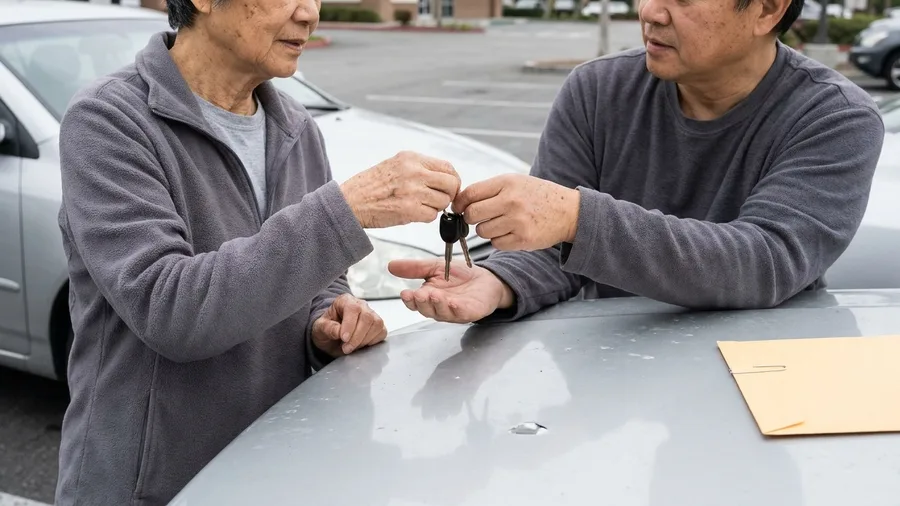
Buying means you own the car outright after the check clears, so you pay $24,000 once for a 3-year-old midsize sedan and then no monthly car payment again. That is the whole appeal, and it is real. What you bought along with the car is a repair bill, a resale price that moves without warning, and four running costs that arrive whether you drive the car or not.
The $24,000 is the easy number to see. The harder one is what the car is worth five years later: in this example, $10,000 at resale. Roughly $14,000 of the purchase price disappears into depreciation, and you only get any of it back on the day you sell.
You will not find depreciation on a monthly statement. It is already spent.
Set the losses beside the price and the shape of owning shows up. Insurance runs about $1,800 a year, fuel $1,500, registration $400, and maintenance and repairs $1,200, because with no lease contract you carry the whole repair risk when the transmission or the brakes need attention. Fuel and registration are predictable; the $1,200 repair line is the one that can jump in a bad year.
Owning fits one kind of driver in particular. You need $24,000 in cash that you can part with, and you need a plan to keep the car five years or longer, because a short hold gives depreciation less time to flatten out while the resale money still comes back to you. Keep it, sell it at $10,000, and the monthly outlay over those years is insurance, fuel, registration, and repairs, never a car payment. There is no mileage cap and nobody to hand the keys back to at the end.
Leasing lowers cash up front but adds contract limits

If the $24,000 in cash is the barrier, leasing answers it with $3,000 due at signing and a payment that starts at $399 a month. The monthly figure looks gentler than a purchase, and it is, but it keeps arriving long after a buyer would have stopped paying anything at all.
Here is how the five years play out in this example. A 36-month lease at $399 a month, with $3,000 down, covers the first three years; a second lease of 24 months at $450 a month, with $2,000 down and $1,500 to start when you account for the whole five-year view. You are paying a car bill every month of the five years, which is the opposite of the own example, where the payments stop once the purchase is done.
The payment is not the whole agreement. The lease allows 10,000 miles a year, and the contract, not the sales conversation, sets what happens past that: excess-mileage charges for every mile over the cap, plus wear charges at return if the paint, tires, or interior come back worse than the lease expects.
Read the mileage and wear clauses before you sign anything. They are the risk, and they are written in the contract.
This path fits a driver who wants to keep more cash in hand and whose driving stays comfortably inside 10,000 miles a year. It does not beat owning on total cost on its own; it trades a large upfront sum for a smaller one and a payment you carry for the full five years.
Going without trades fixed costs for on-demand rides

If a monthly payment is the part you want gone altogether, dropping the car puts a $450 monthly figure in its place: $450 for rideshare, transit, and taxi, which comes to $5,400 a year, or $27,000 across five years. Add $300 a year for the occasional rental for longer trips or family visits, and that is $1,500 more, for a total near $28,500.
The fixed lines go quiet. No insurance, no maintenance, no fuel, no registration, no repair surprises waiting in the driveway. Instead, the cost moves to the moment you need a ride: every trip gets paid for one at a time, and the total depends on how often you go out.
That shift is only comfortable where the rides are there when you call. The $450 monthly ceiling is the number to test against your own week. If transit, rideshare, and taxi service near you are quick and dependable, the budget holds. If trips require long waits or there is no service late or early, the cap gets spent fast and the freedom you planned for does not materialize.
The trade-offs are real on both sides. No car removes repair risk and the whole resale question, but it makes you dependent on local service and charges you per trip rather than in one predictable bill. The $300 rental line covers the trips that do not fit on-demand rides.
Run your own week through the $450 line before deciding. Count the trips, price a few, and see whether the cap covers them.
The Own-vs-Go-Without Cost Stack
What you actually pay for when you keep a car
Insurance and repairs swing the annual math

The nastiest annual surprises live in the owned car's repair line, but the number to watch is the gap, not the bill. Owning runs $1,200 a year in maintenance and repairs in this example; leasing runs $300 a year for the same period, because a new car under warranty mostly asks for oil changes and tires. That $900 difference is the repair-risk premium you pay for keeping a car past its warranty, and it is the one annual line that grows.
Insurance cleans up the middle of the comparison. Own and lease both land around $1,800 a year for the same driver and coverage, so the premium barely separates them. Going without pays $0 for insurance and $0 for maintenance, because there is no car to insure or fix.
That zero is not free money. The $450-a-month ride budget absorbs the trips insurance and repairs would otherwise support, so the cost moves from a fixed annual bill to per-trip spending you see every time you tap a card.
Age and miles push the owned car's repair exposure up, year by year, and there is no contract capping it. The lease's risk arrives all at once, as wear charges at return, read off the contract rather than the monthly payment.
So the annual math has a shape. Own carries the swing. Lease carries a smaller, steadier bill with a balloon at the end. No car flattens the annual lines entirely and pays by the trip.
⚠️ COMMON MISTAKE
Don't compare a lease payment to a purchase price
The $399 monthly lease looks cheaper than $24,000 cash until you add the signing fees, the second lease, and the missing resale check. Compare five-year net cost, not the number on the TV ad.
Depreciation is the owned car's biggest hidden cost

The biggest owned-car cost never shows up as a bill: $14,000 of the $24,000 purchase price disappears in depreciation before the car is sold. Buy a 3-year-old midsize sedan for $24,000 cash, keep it five years, resell it at $10,000, and you have spent $14,000 on the car simply losing value. That averages $2,800 a year, which is more than insurance, more than fuel, and more than repairs.
The hard part is the timing. The car loses value every month it sits in the driveway, whether you drive it or not, and nothing arrives in your hand until the day you sell it.
Depreciation is the quiet line. You feel the fuel bill and the repair invoice; you only reconcile the loss the afternoon the buyer hands over $10,000.
A lease bundles that same loss into the monthly payment, so the depreciation is priced in and disclosed up front, with nothing left to sell at the end. The no-car budget has no depreciation at all, and no asset either.
The $14,000 is not a separate fee tacked onto owning. It is part of the price of owning, and it belongs beside the lease payments and the ride spending when the three paths go side by side.
The Owned Car Over Five Years
Fuel and registration are close for own and lease
Fuel and registration do not change the choice between owning and leasing, because both cars burn the same $1,500 a year in fuel and both cost about $400 a year to register. Put the two columns next to each other and those lines match, so neither option wins or loses on them.
That sameness is useful. It means you can set fuel and registration aside and let depreciation, repairs, and the monthly payment decide between those two paths. The lines matter somewhere else.
Going without pays $0 for fuel and $0 for registration in this example, so those two habits vanish from the budget entirely. What replaces them sits in the $450 a month of rideshare, transit, and taxi spending, which is the money the no-car path actually spends on getting around.
So the routine annual costs are a wash between own and lease, and a straight subtraction for no car. They rarely settle anything. They just quietly confirm which path you are already leaning toward, and they are the first lines to drop off the budget when the car goes.
The five-year total shows the real gap
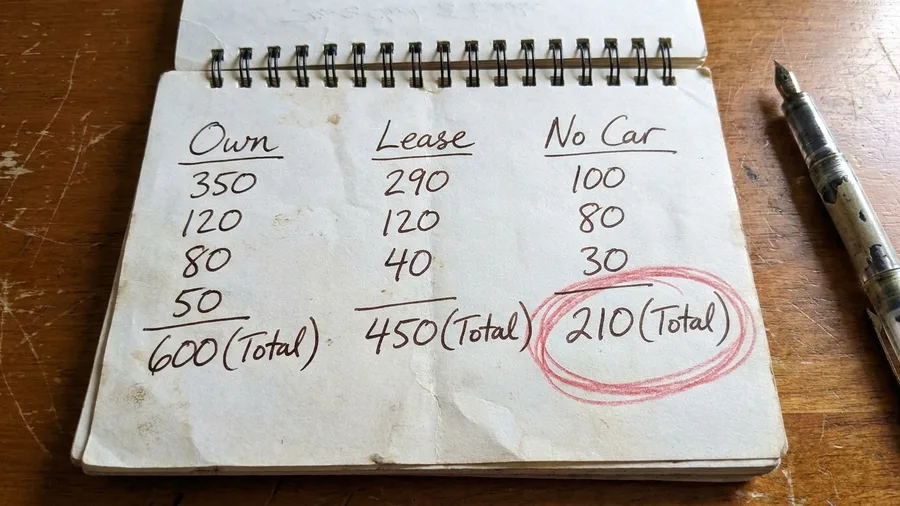
Over five years the cheapest of the three paths is going without a car, at about $28,500. Owning lands in the middle at roughly $38,500 net, and leasing is highest at about $50,200. Those are the numbers to carry into the decision, and each one is built by adding the annual lines to the cash due at the start.
Owning starts with the full $24,000 paid up front for a 3-year-old midsize sedan. Add the running years on top of that and the outlay reaches $48,500 before anything comes back. The $10,000 resale only arrives at sale, so the true cost over the period settles at $38,500. Depreciation is baked into that figure, not tacked on afterward.
The lease runs about $50,200 across the same five years, and it is the most expensive of the three in this example.
The gaps are the part worth holding onto. No car sits $10,000 below owning and $21,700 below leasing. Owning sits $11,700 below leasing. Compare five-year net, then look at what the car actually has to do for you.
Own vs. Lease: Where the Money and Risk Land
Owning
- No monthly payment after purchase
- $10,000 resale value comes back to you
- No mileage cap, drive as much as you need
- Full repair risk as the car ages
Leasing
- Lower cash due at signing
- Payment runs the full five years
- 10,000-mile annual cap with excess charges
- Wear-and-tear bill at return
License and insurance rules need an official check

The official rules that apply to a driver past 65 come from three places: the state DMV, the insurer, and the lease contract, and none of them can be answered from a general example. The five-year totals tell you the shape of the decision. These three checks tell you what it costs and whether you can drive at all.
Start with the state DMV. License renewal, vision testing, and medical requirements vary by state, and age alone does not settle them. Some states want a vision test at renewal, some want a doctor's note after a certain birthday, some want neither. The only way to know which applies to you is to check your own state's rules before you commit to any path that puts you behind the wheel.
Next, get an insurer quote for the specific vehicle and ZIP code. The $1,800 a year in this example is a placeholder, not a quote. Premiums shift with the car, the address, the driving record, and the coverage level, so the real figure can land well above or below the example. That number feeds straight into every annual comparison already built.
The lease contract is the third check, and it is the one most people skim. Mileage allowance, excess-mileage charges, and wear-and-tear terms live in the contract, not the monthly payment. The example allows 10,000 miles a year. Read the return terms before you sign anything.
Driving amount decides lease versus own

Annual miles are what tip the choice between leasing and owning. The lease in this example allows 10,000 miles a year, and every mile above that allowance triggers an excess-mileage charge set by the contract. Drive 14,000 miles a year and you are paying for 4,000 extra miles at whatever rate the contract names, on top of the payment you already agreed to.
Owning carries no cap at all. You can drive the car as far as you like, and the resale value is still there when you sell. The trade is repair risk: the $1,200 a year in maintenance and repairs assumes moderate use, and higher annual miles push that line up. Brakes, tires, and suspension all wear faster the more you drive. High miles and a long keeping plan favor owning.
Low annual miles swing the other way. If you drive under the allowance, the lease payment is doing work the purchase price would otherwise front all at once. Long ownership still favors buying, because the $10,000 resale returns value and the lease's upfront costs are not paid over and over.
Occasional use is a different case entirely. If most trips are short and local, the $450 a month ride budget covers them while $300 a year handles the rental for longer trips.
💡 PRO TIP
Check the lease mileage cap against your real year
Pull last year's odometer readings or your service records and add up the miles. If you are within 1,000 miles of the cap, budget for the excess charge before you sign.
Match the choice to cash, miles, and local rides
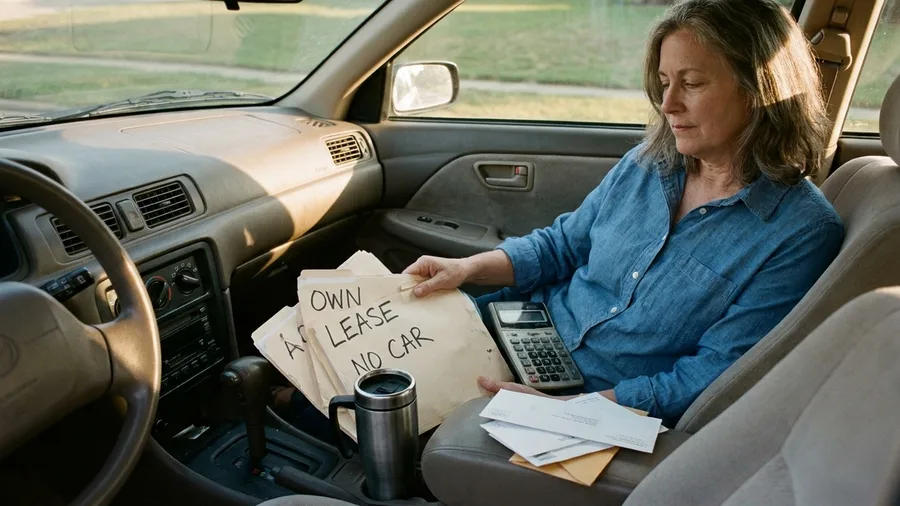
Pick the path whose five-year cost you can actually fund and actually keep up with, and the pick has three tests: cash on hand, annual miles, and whether local rides show up when you call.
Owning is the answer when the $24,000 is genuinely sitting there and the car stays five-plus years. I want the trade-off said plainly, because owning costs the most up front of any of the three: in the example you tie up $24,000 on day one, then $1,200 a year in repairs, and the only money coming back is the $10,000 resale at the end. What you buy for that is no monthly car payment, no mileage cap, and a car you can still sell. The $10,000 is real, but it arrives at the finish line, not during the years when the repair bill lands.
Leasing fits a different driver: $3,000 due at signing is reachable and the odometer stays inside the allowance. In this example the payments run $399 a month for 36 months, then $450 a month for the next 24, and the contract's mileage and wear charges matter more than the monthly number. Read that contract first. It decides the risk.
Going without is the cheapest total in the example, but only if the rides exist. Test it against your actual week: if $450 a month of rideshare, transit, and taxi covers the grocery runs, the appointments, and the family visits, and $300 a year handles the occasional rental, the budget holds. If the rides are thin where you live, the cheapest total fails.
Run it in order. Cash available, then annual miles, then local ride reliability.
🌱 GROWING TIP
Run the five-year test on your own numbers
Write down your cash on hand, your annual miles, and the cost of a typical local ride. Those three figures will point you to the path faster than any monthly payment comparison.
Frequently Asked Questions
Is it cheaper to lease or buy a car after 65?
It depends on how long you keep the car and how many miles you drive. In the example here, leasing costs about $50,200 over five years and owning nets $38,500 after resale, so owning is cheaper for a long-term keeper with the cash. Leasing wins only if the lower upfront cash matters more than the total and your miles stay within the cap.
How much should I budget for rides if I give up my car?
Start with $450 a month for rideshare, transit, and taxi, plus $300 a year for an occasional rental. That is $28,500 over five years in this example. Track your actual trips for a month before you commit, because the budget only works if local rides are reliable.
Do insurance rates go up after 65?
They can, depending on the insurer, the vehicle, and your location. The $1,800 annual figure here is an example, not a quote. Get a quote for the specific car and your ZIP code before you decide, because a real quote is the only number that counts.
What happens if I go over the lease mileage allowance?
The lease contract sets an excess-mileage charge for every mile over the cap, and it applies at return. The example lease allows 10,000 miles a year, so check your annual mileage against that before you sign. Excess charges can erase the upfront savings of leasing.
Can I keep driving after 65 if my vision changes?
That depends on your state DMV's license-renewal, vision, and medical requirements, which vary by state. Check the current rules before you assume anything. If the requirements change your driving, the no-car path with a ride budget is the fallback to plan for.
Cash, miles, and local rides pick the path
Own it if you have the cash and will keep the car five-plus years. Lease if lower upfront cash matters more and your miles fit inside the allowance. Go without if $450 a month in rides covers your local trips. Those three rules settle most of it.
The monthly-payment comparison started you here, and it is incomplete. The five-year net is about $28,500 without a car, $38,500 owning, $50,200 leasing, and cash, miles, and local ride reliability decide which one you can live with.
Before you act, check the state DMV for license-renewal, vision, and medical rules, get an insurer quote on the specific vehicle and ZIP code, and read the lease contract on mileage and wear charges. Then compare five-year cost against the constraints, and take the path you can keep up with, not the one with the lowest monthly payment.
Run Your Own Five-Year Math
Write down your cash on hand, annual miles, and the cost of a typical local ride. Those three figures will tell you which path fits before you sign anything.