

Is it smarter to buy an existing business than start one in your late fifties? Here is the short answer: yes, if you want income inside six months without a 40-hour week, and only if that income survives the seller walking out the door.
You have $75,000 to $150,000 in cash, a retirement account you would rather not touch, and a number in your head: $60,000 to $80,000 a year for 20 to 25 hours a week. What you fear is that ownership means a 40-hour job or a startup gamble with your savings.
It does not have to. Plenty of low-glamour local businesses come with customers, staff already hired, and a seller willing to carry a note, so you are buying day-one income instead of building from zero.
The play only works on three conditions: verified earnings that hold up without the seller, a manager who stays, and a lease and license that transfer before you sign. Below is the menu, the math, the diligence budgets, and the red flags that end deals, ending in a plain verdict on when to buy, when to start, and when to walk.
Boring means repeat demand, not glamour

A boring business sells the same routine thing to the same local customers week after week, and the name on the sign does not matter to them. Routine local demand, simple equipment, and service that repeats without the owner's face attached. Growth and glamour are beside the point; repeat visits are the whole point.
The laundry is the clearest one. Eighteen washers and twenty dryers in a 22-year-old location, and the same households come back every week because their clothes keep getting dirty. You are not selling a washing machine; you are selling the simple business model of a Tuesday afternoon habit that doesn't change when the owner retires.
The rest fit the same mold. A self-serve car wash sells equipment and a corner lot with traffic driving past it. A pest-control route sells scheduled recurring visits, so the revenue arrives in appointments already on the calendar. A small HVAC service sells repair and replacement demand, which never really stops. Self-storage sells leases and gates, and the day-to-day labor is thin because most of the work is a signed agreement and a keypad.
The traits worth hunting for are the same across all five: repeat customers, simple equipment, and labor you can replace. Simple equipment matters because it means a mechanic, not a specialist, keeps the machines running. Replaceable labor matters because the business has to keep operating on a day the buyer is at a grandchild's birthday.
This is staffable, not passive. A manager or the owner still covers oversight: the books, the staff schedule, the maintenance calls, the capital spending decisions. Anyone who says one of these runs itself has never read the repair invoice on a commercial washer.
Three things disqualify a business from the useful version of boring. If the owner's name is what draws the customer, there is nothing to buy but a phone book. If a fad is driving demand, the customers leave when the fad does. And if one big contract is the revenue, you do not own a business; you own an account that can cancel.
None of those fit the buyer who wants $60,000 to $80,000 from a 20-25 hour week, because none of them come with customers who will still show up after closing day.
Existing cash flow beats a startup runway

The reason to buy rather than start is that repeat demand already on the books is worth cash from month one, and a build-out is worth nothing until the customers show up. Look at what each side actually gets you.
The existing side, in the laundry example: a $300,000 purchase price for a 22-year-old business with $85,000 in seller's discretionary earnings and a manager already running the floor. Seller's discretionary earnings is the profit the seller takes out before interest, taxes, and depreciation, and it is the number everything else hangs on. You are buying the customers, the staff, and the revenue in one closing.
The startup side, in the mobile HVAC example: about $45,000 to launch, then 12-18 months of knocking on doors to build a customer base, and 40-plus hours a week in year one. That $45,000 buys you control and a learning curve. It buys no revenue, and it buys no income until the phone starts ringing.
Here is the trade-off in plain terms. Buying means you pay for someone else's customers and inherit their problems. Starting means you build your own and eat the empty months. Neither is free.
For a buyer who wants income within six months and a 20-25 hour week, the existing business fits and the startup does not. A 12-18 month runway with no revenue is not a retirement plan; it is one of many low-stress side incomes for retirees with worse hours than the one you left.
| Decision point | Buy existing | Start from scratch |
|---|---|---|
| Cash needed up front | $75,000 down on a $300,000 laundry | About $45,000 to launch a mobile HVAC service |
| Time to revenue | Day one, with staff and customers in place | 12-18 months to build a customer base |
| Hours in year one | 20-25 with a manager in place | 40+ a week, owner-operated |
| Control | Shared with manager and lease | Full |
| Biggest risk | The seller takes the relationships out the door | No revenue while the runway burns |
The menu favors repeat demand and simple equipment

The five businesses that supply that day-one cash flow, at illustrative prices: a pest-control route around $250,000, a coin laundry around $300,000, a self-serve car wash around $450,000, a small HVAC service around $550,000, and self-storage with property around $1,200,000.
The lower half of that list earns its place on simple mechanics. The pest route runs on scheduled recurring visits, so next month's revenue is already booked. The laundry runs on repeat weekly use and eighteen washers and twenty dryers. The car wash runs on simple equipment and a location where the traffic already goes.
The upper half earns it on demand that does not dry up. Small HVAC is repair and replacement work, and the service calls are staffable by technicians. Self-storage runs on leases and gates with low daily labor, but you are paying for property and scale, which is why it sits at the top of the range.
None of the five is passive. Each one needs a manager or owner covering the books, the staff, the maintenance, and the capital spending. The 20-25 hour week is an oversight budget, not a claim that the business runs itself. Someone still has to cover daily operations, and your job is to make sure that is a manager or a plan, not a hope.
Purchase prices start near $250,000 and climb

Verified earnings set the price; everything else is just the story around them. A pest-control route sits at the bottom around $250,000, the coin laundry lands at $300,000, and self-storage with the property included climbs to $1,200,000. Same category, wildly different checks, because you are buying different things.
Four factors move the number. Equipment age, lease terms, customer contracts, and whether real estate comes with the deal. A car wash at $450,000 costs more than a route at $250,000 largely because you are paying for the building, the bays, and the land underneath them, not because the demand is better. An HVAC service at $550,000 carries a staff and a service truck fleet that the route never touches.
Run the laundry math out loud. A $300,000 asking price against $85,000 in seller's discretionary earnings — the profit the owner takes out before debt, taxes, and some one-time costs — works out to roughly 3.5 times that figure. Then read the manager's $65,000 salary alongside it. That salary comes out of the $85,000 before you see a dollar, which leaves about $20,000 of net profit on paper if you did nothing else.
Here is where your cash caps the deal. At $75,000 to $150,000 down, you can put a meaningful slice on a $250,000 route or the $300,000 laundry. You cannot touch the $1,200,000 storage property without a far larger loan and a far deeper reserve. The price only works when verified earnings and the manager structure still leave income after the debt payment takes its cut. If the number on the page does not clear that bar, the price is not the problem — the deal is.
Seller financing fills the bank's gap

You fill the gap with the seller's money, not your own. A retiree buyer rarely walks in with cash for the whole price. The usual stack is your cash down, a commercial loan, and a seller note — a slice of the price the seller agrees to carry and collect from you over time, rather than pocketing up front.
Take the laundry again. $300,000 price, $75,000 cash down, and a $225,000 seller note over 7 years. The seller is now essentially your lender for three-quarters of the deal. That is not a favor; it is the seller betting the business keeps earning enough to pay them back, which gives you leverage to demand they open the books.
A commercial lender or an SBA-backed loan — the federal program that guarantees part of a small business loan — fills in the rest if a seller will not carry the full gap. The lender decides based on two things: the business's trailing cash flow and your written plan for who runs it day to day. Your age does not enter into it, and any rate or guarantee figure has to come from the lender, not from a rule of thumb.
Then run the deal forward. After the seller note payment and the manager's $65,000 come out, does the laundry still put $60,000 to $80,000 in your pocket for 20 to 25 hours a week? If yes, the structure holds. If no, you do not push harder — you renegotiate the price, stretch the note, or walk. The financing is only a bridge to the income, never a substitute for it.
How much of your week each ownership model eats
Severity here is hours consumed per year, not risk of failure
- Oversight with a manager: 20-25 hours a week: books, staff, maintenance, capital approvals
- Seller-dependent business: The seller runs it now; you inherit the hours after closing if no manager is in place
- Buying yourself a job: No manager, seller-only relationships, month-to-month lease
- Starting from scratch: 40-plus hours a week for 12-18 months before the customer base pays
The management trap turns ownership into a job
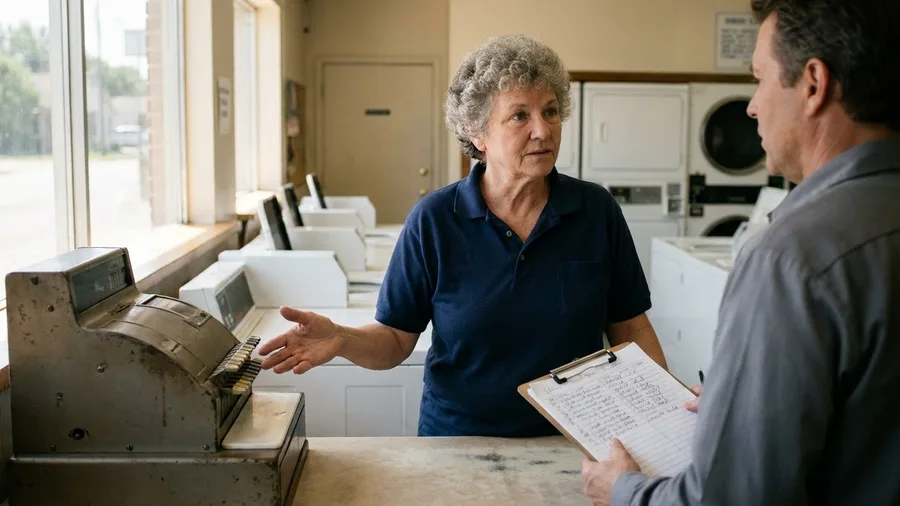
If the seller was the operator, you inherit the job unless you replace the labor. The business does not run itself because the sign says laundry on it. Someone has to open the doors, handle the machines, deal with customers, order supplies, and manage the person doing all of that. That someone was the seller, every day, for years.
In the laundry deal, a manager already stays on for 12 months at $65,000 a year. That gives you a full year to learn the business and to find or promote a permanent replacement. But month 13 is the real test. The buyer who has not solved the manager question by then is now the manager, and the 20 to 25 hour a week target is already gone.
Even with a manager in place, your job does not vanish. You review the books, approve capital spending — a new washer, a roof repair, a security camera system — and you handle the bank, the taxes, and the hiring and firing. Those tasks sit with the owner no matter who runs the floor. A manager runs operations; you run the asset.
So ask the one question that decides everything. Who runs the day if the manager quits? If the honest answer is you, the purchase is a job with a down payment, not income. If the answer is a plan — a named replacement, a hiring budget, a recruiter — then the $85,000 in earnings is real for a 20 to 25 hour week. If you cannot replace that labor at a known cost, the hours eat the retirement before the income ever reaches you.
⚠️ COMMON MISTAKE
The seller is not the business
If the seller owns the customer relationships or the only operating knowledge, the earnings you are paying for may not survive the sale. Verification and a manager plan are the only antidotes.
Due diligence is a books-and-lease exercise
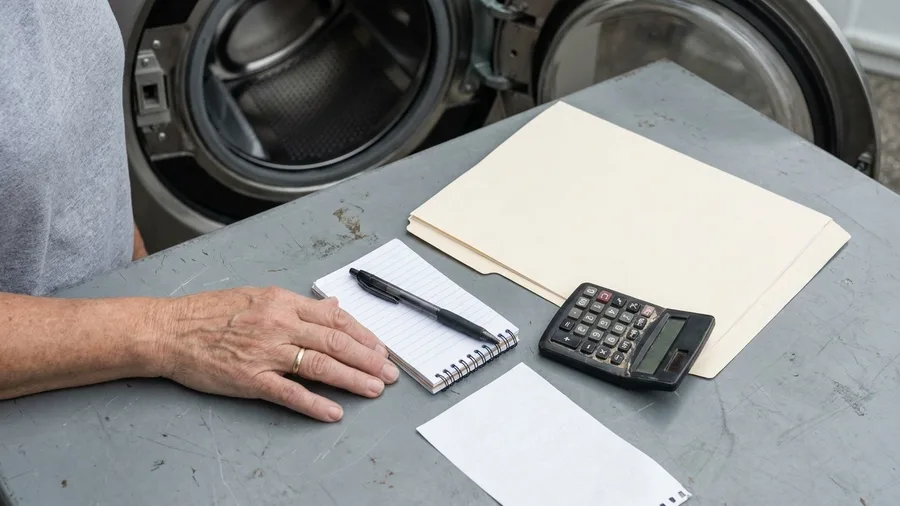
Before you sign anything, you pay for three checks that tell you whether the seller's story is the truth: a quality-of-earnings review, a lease review, and an equipment inspection. The earnings review is the one that matters most, and it is not cheap. Budget $3,000 to $8,000 for a quality-of-earnings review — an accountant's independent restatement of what the business actually earns once add-backs are stripped out. Add about $1,500 for a lease review. That is real money before you own a single washer.
The books checks are specific. You want customer concentration, meaning how much of the revenue rides on a handful of accounts that could walk. You want the seller's add-backs — the personal expenses and one-time costs he added back to inflate earnings — restated by someone whose fee you paid, not his. And you want deferred maintenance, because a machine that has not been serviced in two years is a bill you inherit.
That last one belongs in the price.
On the laundry, set aside $15,000 as a machine reserve. Eighteen washers and 20 dryers that are 22 years old will need work, and the inspection tells you how much. If the equipment is tired, the $15,000 reserve and the verified earnings together decide whether the $60,000 to $80,000 target still clears repairs and the debt service on that $225,000 seller note.
Scan the seller's post: what each signal means
- Documented systems and staff who stay — Green lane: the business operates with or without the seller
- Assignable contracts and equipment reserves — Green lane: the income can change hands intact
- Month-to-month lease — Caution: the landlord can change the deal under you
- Aging equipment with records — Price it with a $15,000 reserve, not a shrug
- Seller holds every customer relationship — Stop: the earnings may walk out the door
- One big contract is the revenue — Stop: that is a job with a client, not a durable stream
Due diligence doesn't remove risk; it prices it.
Owner dependence is the red flag that kills deals
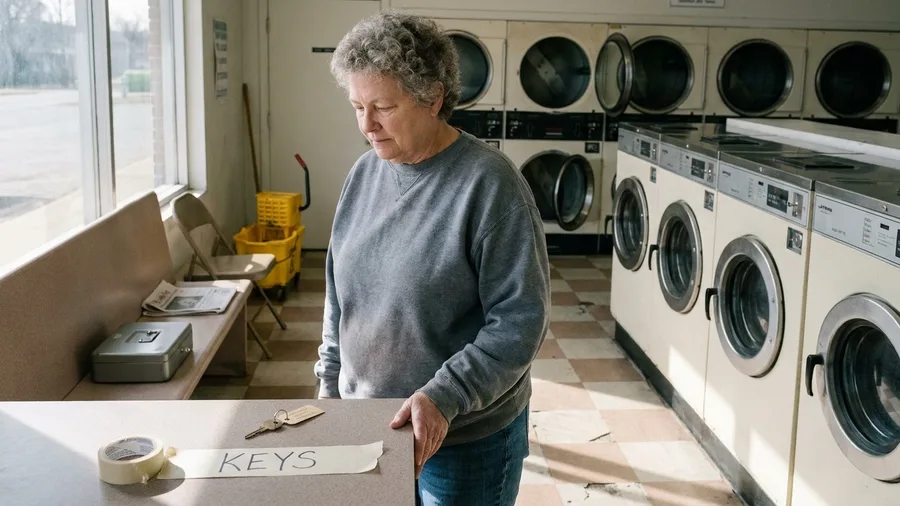
Clean books tell you the money was real. They don't tell you it will keep coming after the seller walks out the door.
The warning signs cluster around one person. Three or four customers who account for most of the revenue. Accounts the seller handles personally, on a first-name basis, with no contract behind them. A lease that renews month to month. Equipment that was due for replacement five years ago and wasn't. Maintenance that got deferred because the owner was tired and the fix could wait one more season. None of these show up as a line on the quality-of-earnings review. All of them mean the earnings belong to the seller, not to the business.
The same category can be safe or a trap depending on what's documented. Written systems, staff who say they'll stay, contracts that assign to a new owner, a landlord willing to sign consent, machines with real service records. A laundry with an 18-washer, 20-dryer floor and a manager who has run it for years is a different asset than the same square footage where the seller opened the door every morning at six.
Ask one question: whose hands and whose relationships make this money after closing? If the answer is the seller's, and you can't replace that role or hire someone at a known salary, the purchase is a job with a down payment.
The boring label doesn't protect cash flow. A walk-away list is short: seller-only relationships, an unassignable lease, obsolete equipment with no reserve, and no manager you can name. Any one of those, and the number on the listing is a story about the past.
Licenses and leases must transfer before closing
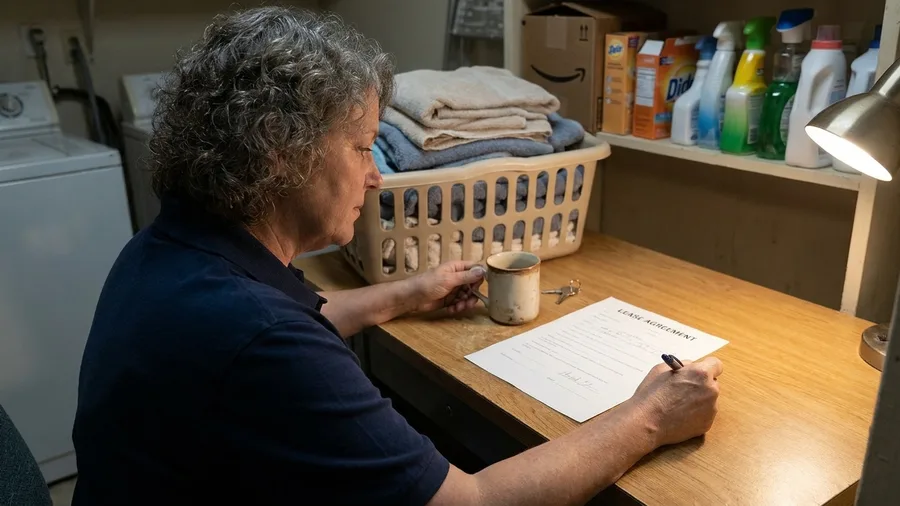
Even with a manager in place, the income has no legal path if the lease, license, permits, or contracts can't move to your name.
Take the laundry. Its lease runs seven more years with a five-year option behind it, and on paper that term is the cushion you're buying. It means nothing without the landlord's written consent to assign. A landlord who likes the current tenant, or wants a rent bump, or wants the space back, can decline, and the seven years become a number in a document that no longer binds anyone. Get that consent in writing before closing day, not a verbal maybe.
Then work through the rest. The city business license has to issue in your name. The equipment permits have to follow. Key contracts have to be assignable, not tied to the seller personally. Don't guess at any of it. Your state licensing board and the city business license office will tell you the rules for that specific business, and a business attorney is the person who reads the assignment clause and tells you what it actually requires.
A business that can't transfer its lease or license is a collection of used equipment sitting in a rented room.
verified seller's discretionary earnings of $85,000 are worth $85,000 only if the route, the license, or the lease arrives with you at closing. Miss one and the income stops at the door.
Signals under the boring label
Durable income
- Earnings verified by a quality-of-earnings review
- A manager or staff who stay after closing
- Assignable contracts and a consenting landlord
- $15,000 equipment reserve in hand
- 20-25 hours of oversight, not labor
A job in disguise
- Seller owns the customer relationships
- No manager and no replacement pipeline
- Month-to-month lease or license at the seller's name
- Deferred maintenance hidden in the price
- The buyer runs the day when the manager quits
Buy for income; start only for a new model

Three outcomes are left once the transfer checks come back clean: buy verified, start under conditions, or walk. Here is how each fits a person who wants income and a 20-25 hour week. The $300,000 laundry makes the buy case almost by itself. It carries $85,000 in seller's discretionary earnings, a manager already on payroll, and a path to income within six months at the hours you have in mind – customers, staff and cash flow that exist on day one, not on a spreadsheet you build from scratch.
The start case is a different animal. A mobile HVAC service runs about $45,000 to launch, and it hands you full control of pricing, brand and schedule. It also takes 12-18 months to build a customer base, with 40+ hour weeks in year one. That is a reasonable trade if you have the time and the operating appetite for it, and a poor one if the whole point of the exercise was fewer hours.
The fit rule is blunt because it has to be. Buying suits the retiree who needs income and limited hours now; starting suits the buyer with time, appetite and a concept worth building.
And the walk-away threshold sits underneath both: no manager, no verified earnings, or no reserve means you step back and let the deal go, whichever column it was in. A $15,000 equipment reserve and a quality-of-earnings review are not optional line items – they are the test of whether the income and the hours can both be real. Without them, buying and starting fail the same way.
Frequently Asked Questions
How much do I need in cash to buy a boring business?
A common structure is $75,000 to $150,000 cash for down payment and reserves. On a $300,000 laundry, the example uses $75,000 down and a $225,000 seller note, plus $3,000 to $8,000 for a quality-of-earnings review, $1,500 for lease review, and a $15,000 equipment reserve.
Can I get a loan for this in my sixties?
Lenders look at the business's cash flow and your management plan, not your age. Many buyers also use some seller financing to fill the gap. Check current eligibility, rates, and guarantee rules with a commercial lender and the SBA; those details change and depend on your file.
Is a coin laundry actually passive?
No. It is staffable, which is not the same thing. With a manager in place, the buyer's week is about 20 to 25 hours of books, staffing, maintenance, and capital approvals. If the manager leaves and you have no replacement, you inherit the daily work.
How do I know the earnings are real?
Pay for a quality-of-earnings review ($3,000 to $8,000) and a lease review ($1,500). Check customer concentration, the seller's add-backs, and deferred maintenance. The seller's story is not verification.
What should make me walk away?
Walk if the seller owns the customer relationships, if no manager is in place and you cannot hire one, if the lease or license will not transfer, or if you cannot replace the seller's role. Those turn the purchase into a job, not income.
Check Who The Seller Actually Was
Your $75,000 to $150,000 in cash can buy a staffed, verified $300,000 laundry and pay you for oversight. It can also buy a job if the seller was the business and you never replace that role. The difference is not the price on the listing; it is whether the income survives the seller's exit.
The boring-business play is income that outlasts the person who built it, not glamour or control.
So decide outright. Buy an existing boring business when the earnings are verified, a manager is in place, and the lease and license can transfer. Start from scratch only if you have the time, the operating appetite, and a concept worth building yourself. Walk away from both if the seller is the business or you cannot replace the seller's role — because that is the test that keeps the income from becoming a job.
Run the income-and-hours test before you fall for a listing
Compare the verified SDE, the manager cost, and the debt service against your own 20-to-25-hour week. If the number does not clear, the deal does not belong in your retirement.