

Your neighbor mentions a high-yield account, your cousin keeps bringing up Treasury bills, and your savings statement shows the same bank and the same balance line creeping up a few hundred dollars a year. The gap you feel is real, but not the way you think.
Take $50,000 sitting in a big-bank savings account from January 2021 to January 2026, interest credited monthly, no deposits, no withdrawals. The balance only goes up. Yet the account never once shows a loss: prices rose faster than the APY, and the space between the balance and what it buys is the entire cost.
Your balance was never your buying power. With the statement and the official CPI-U change at bls.gov/cpi, you can turn that gap into one real-return number you can say out loud, then split the pile so the money you need stays safe and the rest stops losing ground.
By the end, a copyable split: $10,000 in checking for bills, $25,000 in an FDIC-insured online savings account, $15,000 in a 12-month CD ladder across three CDs, with the cash sleeve sized by essentials times months instead of a round number.
Cash lost ground even while the balance grew

It cost you, and the account never said so. Twelve monthly interest credits land in a year, each one bumping the balance a few dollars, and not once does the number dip. No withdrawal fires, no payment bounces, no fund price drops on a morning you needed the money. The line only climbs, which is exactly why a loss this size can sit in an account for five years without a single event to mark it.
Run the same $50,000 from January 2021 to January 2026 and the statement reads clean at the end. The grocery total does not. Prices climbed every month whether or not the account did, so the pile covers a smaller share of the same cart by the last January than it did in the first. The gap between the balance and what it still buys is the cost, and it never shows up as a line item.
No bank debits this. It comes as a higher price on the same items, spread thin across years, which is why a spotless statement and a real loss can sit in the same folder.
Two inputs settle it. First, the CPI-U change from January 2021 to January 2026 at bls.gov/cpi. Second, your own APY history, pulled from those monthly statements and checked against the FDIC national rate at fdic.gov to see whether the old bank paid anything close to competitive. Match the periods, divide, and the number you get is what the pile still buys.
A $50,000 pile shows the size of the hole

Here is the arithmetic, run end to end. Start with $50,000 parked in a big-bank savings account in January 2021, no deposits, no withdrawals, every interest credit left in place. Open the January 2026 statement and write down the closing balance first, because that is the figure the loss has to be measured against now.
That closing balance will sit above $50,000, and the gap matters. Because interest stayed in, the inflation bite gets measured on the larger number, not the original stake. The real question is purchasing power minus $50,000: did five years of interest outrun five years of prices, or fall behind? Do the division on the grown balance and you get the honest answer.
The method takes four moves. Take the ending balance off the statement. Take the CPI-U change for the same window from bls.gov/cpi. Divide the balance by one plus that change to get purchasing power. Subtract purchasing power from the balance to get the shortfall.
Scaling is straight line, so you only run it once. Double the pile to $100,000 and the shortfall doubles; quadruple it to $200,000 and the shortfall quadruples. Same formula, same CPI figure, different starting stake.
| Option | Access to the money | What it protects | What it costs you | Where to check the current number |
|---|---|---|---|---|
| Big-bank savings | Immediate, in checking or at the ATM | The balance up to FDIC limits | A $12 monthly fee unless $2,500 is kept; purchasing power falls with inflation | Your statement and fdic.gov for rates |
| FDIC-insured online savings | Two business days to checking | The balance up to FDIC limits | Nothing to open or hold; rate can change | fdic.gov national rates |
| 12-month CD ladder | Rungs mature a few months apart; early withdrawal costs a penalty | The balance up to FDIC limits and the rate for the term | Early-withdrawal penalty if you need the money before maturity | Your bank's CD disclosure and fdic.gov |
| TIPS or I bonds | TIPS can be sold, I bonds have holding periods and limits | Principal adjusts with CPI (TIPS); earnings include an inflation rate (I bonds) | Purchase limits, holding periods, tax wrinkles | TreasuryDirect.gov and IRS |
| Checking for bills | Immediate | Nothing beyond the balance for monthly bills | No growth; $10,000 here is for bills, not for saving | Your own budget |
Nothing failed, which is why the loss hides

You did nothing wrong, and that is the part worth sitting with. Every deposit stayed insured, every interest credit posted on schedule, no payment failed, no fund dropped on a day the cash was needed, and nothing forced a sale at a bad price. Measured against what a savings account promises, this one kept every promise it made.
That is not a small thing. Cash guards against default, against a market fall on the exact day you need the money, and against not being able to sell at any price. Those protections are why the $24,000 emergency sleeve was sitting in cash in the first place, and they are real.
On insurance, check the current coverage limit yourself at fdic.gov rather than trusting a number from any article, including this one, and confirm that your own balance falls inside it.
The loss here moves slowly and arrives as prices, not as a statement event. There is no day you open the envelope and see it. It only appears later, when you compare what the same money bought in January 2021 against what it bought in January 2026, and the second cart comes up short. Understanding why sticky prices keep climbing explains why that shortfall lingers even after inflation cools.
The order of events mattered more than the average

The timing of yields versus prices did more damage than the five-year averages suggest, because the two did not move together. In early 2021, savings rates at big banks sat close to zero while prices were already climbing. Prices kept rising through 2022 and into 2023 before savings rates meaningfully responded. Pull both series from bls.gov and fdic.gov yourself rather than trusting a remembered number.
Picture two people with the same $50,000. One moves it in 2021 and catches each later rate increase as it arrives, so a growing share of the balance earns the better rate for more of the period. The other gets around to it in 2023.
By then, most of that five-year price change had already landed on the balance. The 2023 mover spent the early inflation years earning the old bank's APY, arrived late, and missed the chance to earn a competitive rate during the exact stretch when purchasing power was falling fastest.
the months when yields were near zero and prices were not.
A higher yield in 2025 cannot retroactively pay you for 2021. The cheap-yield-then-price-rise-then-better-rate order is the thing that cost money, and a single line of averages erases it. This is not a one-off, either, which is why the sequence matters more than any annual figure.
For the reader holding $50,000 now, the lesson is forward-looking. If savings rates fall while prices keep moving, the same gap opens again. Check what your account pays today, not what it paid last year, and check it against the inflation reading at bls.gov rather than against your own comfort.
The word safe was doing two jobs
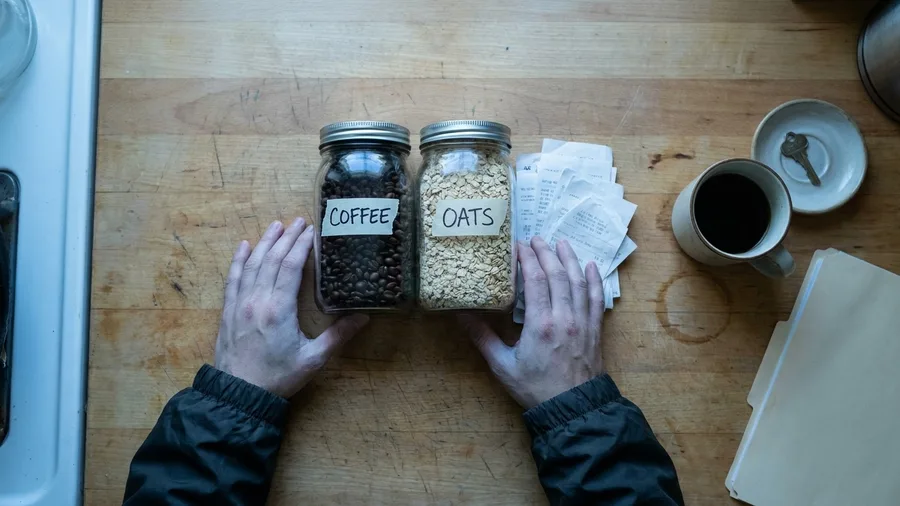
The word was carrying two promises at once, and only one of them was ever insured. The balance is guaranteed up to the FDIC coverage limit, so that $50,000 will be there, to the dollar, whenever it is asked for. What it will buy when it is asked for has no guarantee attached to it at all.
The two promises sit on the same statement line and look identical, which is why nobody separates them until the price comparison forces it.
The same split runs through every product sold as safe. A CD or a Treasury bill fixes the number and fixes the date, and fixing both still leaves purchasing power exposed for the whole term. Nothing in the list removes risk. Each one picks which risk the money carries, and the picking is the actual decision.
So the question stops being whether cash is safe and becomes what job each dollar has. Money leaving the account inside twelve months needs the nominal guarantee and same-week access more than it needs growth; that is the $24,000 emergency fund, six months of $4,000 essentials, and it earns its keep by being there in a bad month. Money with a date on it, like the $15,000 ladder, trades a little access for a known rate over a known span.
Money not needed for ten years is the opposite case. It needs purchasing power and growth, and parked in cash it loses ground on a schedule, year after year, with the balance still climbing.
Same account, same insurance, three different jobs, three different risks. Naming the job is what makes the rest of the split obvious.
💡 PRO TIP
Check the rate, not the app
A bank can advertise a competitive rate and still pay the old one after the promotion ends. Pull the APY from your last three statements and compare it to the FDIC national rate at fdic.gov before you decide anything else.
The fix was usually a different account

The first practical fix kept the same insurance and the same access and only changed the rate, so the reader with $50,000 did not need a new asset at all. This is a rate change, not risk-taking. An FDIC-insured online savings account can pay a competitive yield while the big bank keeps paying the old APY on the same deposit.
The mechanics take an afternoon. Open the online savings account, link it to your existing big-bank checking, and move the money over. The online account typically charges no monthly fee and transfers back to checking in about two business days.
Two business days is the number to sit with. That is the access you are trading for a much better rate, and it is well inside the notice you would want on an emergency fund anyway. Your six-month sleeve of $24,000 does not need same-hour liquidity.
The old bank has its own math. If it charges $12 a month unless you keep $2,500 on deposit, that fee is $144 a year, and it only bites if the balance drops below the threshold. Keep $2,500 there and the fee disappears. The $10,000 checking sleeve in the split already clears it, with room to spare.
Before you move anything, check three things. Confirm the FDIC coverage on the online account at fdic.gov, verify the transfer time to your checking, and read the rate terms closely. An advertised rate can be promotional and drop after a few months, so ask whether it is ongoing or temporary.
None of that changes the insurance or the access. It changes what the same dollars earn while they wait, and that is the entire point.
Locking up cash paid more only on a schedule

Tying the money up pays more than a savings account only when there's a date on it. That's the whole rule. A CD or a Treasury bill beats the online savings rate because the bank or the government knows exactly when it gets the money back and prices the rate accordingly — but the moment that date is imaginary and the money gets needed early, the same instrument becomes the expensive choice. Comparing T-bills, bond funds and CD ladders shows how that trade-off plays out in the current rate landscape.
The cost of getting it wrong is specific. Cashing a CD before maturity triggers an early-withdrawal penalty, often several months of interest — on a $5,000 CD at 4%, a three-month penalty is around $50 right off the top. Selling a T-bill before it matures can bring back less than holding it to the end, because the price you get depends on rates that week, not the rate you signed up for.
The shape that solves this for $15,000 is a ladder: three CDs of $5,000 each, maturing a few months apart across 12 months. One rung comes due every four months, so a chunk is always close to reachable without cashing the whole pile at one rate on one day. If rates rise, the next maturing rung rolls into the better rate. If cash gets tight, one rung breaks instead of the whole thing.
Who this suits: taxes due in April, tuition, a down payment inside two years. Not the emergency fund — that has to be reachable without penalty, which is why it stays in the online account. The ladder is for the money that has a name and a month on the calendar.
The $50,000 Split at a Glance
🏦 Checking
$10,000 for monthly bills
💳 Online savings
$25,000, insured, no monthly fee
📅 CD ladder
$15,000 across 3 CDs over 12 months
🛟 Emergency sleeve
$24,000 = 6 months of $4,000 essentials
Why it works
Each dollar gets a job, and the fee waiver at the old bank is met by the checking balance alone.
Inflation-protected options swap one guarantee for another

A ladder solves the date problem but still leaves the purchasing power problem exactly where it was, which is why the two holdings that actually react to inflation deserve a look. There are only two cash-like ones: TIPS, where the principal gets adjusted along with CPI, and I bonds, where a fixed rate and an inflation rate get reset on the official schedule posted at TreasuryDirect.gov.
That adjustment is the whole point. Your principal number keeps pace with prices instead of sitting flat while prices climb past it.
You pay for it in three currencies. Purchase limits cap how much you can put in over a year, holding periods mean money you might need in six months does not belong here, and there are tax wrinkles at both federal and state level, some of which only show up when you file.
Get the current limits, holding periods, and tax treatment from TreasuryDirect.gov and the IRS directly, because those numbers get revised and any figure printed in an article is already stale by the time you read it.
In one line: you are trading access and simplicity for inflation protection.
For this $50,000 pile, none of it belongs in the emergency sleeve. The $24,000 has to be reachable without penalty and without paperwork on a Tuesday night when the furnace quits. What TIPS and I bonds could do is hold the portion of the money not needed for years, the part that can sit through the forms and the annual limits without anyone missing it.
All Cash vs. Splitting the Pile
All cash
- The whole $50,000 loses purchasing power together.
- No fee, but no competitive rate either.
- Feels safe, but buys less each year.
- Easy to understand, hard to grow.
Split the pile
- Bills money clears the $2,500 fee waiver.
- Emergency sleeve sits in an insured online account.
- Dated money earns in a 12-month CD ladder.
- Long-term money stays invested, outside this pile.
Splitting the pile beat picking one answer
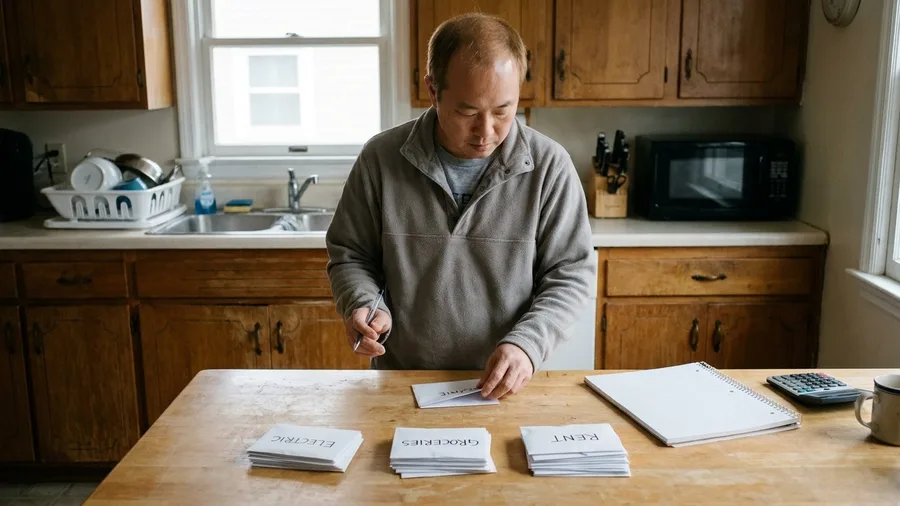
Single option does every job in the pile, so the fix is to stop hunting for one answer and give each dollar a job instead. Here is the same $50,000 redivided: $10,000 in checking to clear monthly bills, $25,000 in an FDIC-insured online savings account, and $15,000 in a 12-month CD ladder split across three CDs maturing a few months apart.
Each sleeve earns its place. The checking balance clears the $2,500 threshold that waives the $12 monthly fee at the old bank, so the account stops costing you $144 a year. The online savings holds the emergency fund. The ladder holds the money that has a real date attached to it.
Do the sizing on the emergency sleeve and it lands at $24,000, which is six months of $4,000 essentials, not some round figure picked because it sounds sturdy. That $24,000 sits inside the $25,000 online balance, with the leftover $1,000 as a small cushion for the months that run long.
Compare it to the two extremes and the reason holds. Leaving everything in the big bank keeps the entire pile losing purchasing power together. Moving all of it out at once means a bad year arrives, the furnace dies, and you are cashing something at the moment it is worth least. The split lets the emergency money be boring and reachable while the dated money earns a scheduled rate.
One thing to be clear about: this is the cash side of the balance sheet only. Long-term money stays in its own sleeve, invested, untouched by any of this shuffling.
The numbers that size the cash sleeve
Use your own essentials and months, not a round number
Some cash is still right, at this size

The sleeve has a size, and it comes from your life, not from the pile. Three to six months of essentials is the anchor: for a household spending $4,000 a month on rent, food, utilities, insurance and transport, that is $12,000 to $24,000, held insured and reachable. Not $50,000 because $50,000 is what happens to be sitting there.
Reach for the longer end when the outflow is harder to predict. A business owner floating inventory and payroll, someone saving a down payment they plan to spend inside two years, a household near retirement already drawing on the money, all of them need more months than a steady salaried worker does.
Running the other way, there is a real cost to moving out of cash and having to come back in a bad year. Selling something at the wrong moment to cover a furnace or a layoff is a worse loss than the inflation drag on a few thousand dollars.
That is why the buffer gets funded first and stays funded. It is not the money that earns; it is the money that stops you from selling the money that does. Size it as essentials times months, then leave it alone.
Whatever is left over has a different job and belongs somewhere other than a savings account. Tonight, write your own monthly essentials on one line and multiply by six.
What to do this week, in order

Start with one hour at the kitchen table and two pieces of paper: the January 2026 statement and the January 2021 starting balance. Pull the CPI-U change for those same five years at bls.gov/cpi, then pull the account's APY off each statement, year by year, so you know what the money was actually paid and not what you remember it paying.
The math fits on one line: ending balance divided by one plus the CPI change, that result divided by the starting balance, minus one. That is your real return, and it will likely be a small negative number.
Say it out loud. Not because it's pleasant, but because a number you've spoken is a number you stop avoiding, and tonight's real task is that sentence, not a transfer.
Once you've said it, the moves are quick. Move the $24,000 emergency sleeve to an FDIC-insured account paying a competitive rate and start the transfer the same day, because idle days are the same old problem in a new place. Leave $10,000 in checking at the old bank so the $2,500 balance keeps waiving the $12 monthly fee.
Then the dated money: $15,000 into three CDs maturing a few months apart across 12 months, so no single rung holds the whole pile at one rate. Whatever's left stays where it is, invested per the plan you already have. No fund picking, no research required.
The sizing rule underneath all of it: essentials times months, never a round number. For this household, $4,000 times six is $24,000, and that figure, not the $50,000, is what decides how much cash you hold.
Frequently Asked Questions
Is it really a loss if the balance never went down?
Yes, because the same balance buys less. The account did its job and the number stayed stable, but prices rose. Compare what the balance buys today with what it bought five years ago; the gap is the loss, and it does not appear as a line item.
What inflation number should I use for my own calculation?
The CPI-U change for the exact months you held the cash. That series is at bls.gov/cpi. If you held the money for three years, use the three-year change, not a five-year one. The formula is ending balance divided by (1 + that change).
Should I move everything out of cash right now?
No. Keep three to six months of essentials in an insured, reachable account. For a household spending $4,000 a month on essentials, that is $12,000 to $24,000. Moving everything risks needing money back in a bad year and having to sell at the wrong time.
Is a CD worth it if I might need the money early?
No. CD early-withdrawal penalties and selling a T-bill before maturity can leave you with less than you put in relative to holding to maturity. CDs suit money with a known date, like taxes or a down payment inside two years, not the emergency fund.
Do TIPS or I bonds protect my cash from inflation?
They adjust for inflation, but they come with purchase limits, holding periods, and tax wrinkles. Check the current rules at TreasuryDirect.gov and the IRS. They are not the emergency sleeve; they are a possible home for money you will not touch for years.
How do I know if my bank is paying a competitive rate?
Pull the APY from your last three statements and compare it to the FDIC national rate at fdic.gov. If your rate is well below the national average and it is not promotional, the move to an FDIC-insured online account is usually the first fix.
The statement, the CPI number, and the sleeve size that ends the guessing
Cash is safe as a number and unsafe as purchasing power. That much is settled. The five-year cost is real, measurable, and it is fixed by two things, not one: a buffer sized to your actual life, and a different account for the money that does not need to sit in cash.
Four steps, in this order. First, the one-hour job: pull the last statement, find the January 2021 starting balance, look up the CPI-U change at bls.gov/cpi, and compute the real return with the account's own APY history against the FDIC national rate. Second, move the emergency sleeve to an FDIC-insured account paying a competitive rate. Third, ladder the dated money. Fourth, leave the rest invested per whatever plan is already in place.
The balance only went up. By January 2026 the same $50,000 bought less, and the statement stayed clean because the loss arrived as prices, not a fee.
So size the sleeve by your essentials times months. $4,000 times six is $24,000, and that number, not the $50,000, decides how much cash you hold. Tonight: pull the statement and compute the real return.