

Yes – a 1% annual fee can quietly cost you about 28% of your ending balance. Here is the part the headline skips: it is not a rip-off, it is arithmetic, and it has a shape you can see.
Run the numbers on $100,000 left alone for 35 years at an assumed 7% a year. With no fee you land near $1,067,000. Pay 1% a year, netting 6%, and you land near $769,000. That is a $299,000 gap, and roughly two-thirds of it is growth those fee dollars never earned.
The fee is not a slice taken once from what you put in. It is 1% of the whole balance, charged every year, whether the year was good or bad. So whether it is worth paying comes down to two things: what the fee actually buys you in writing, tax handling and steadier behavior, and the all-in dollar cost against a 0.25% alternative.
By the end you should be able to pull fee dollars apart from lost compounding, judge a service list on its merits, and ask for one number first – last year's total cost in dollars, fund expenses included.
| All-in annual cost | Value after 20 years | Value after 35 years | 35-year gap vs. no fee |
|---|---|---|---|
| 0% | $387,000 | $1,067,000 | — |
| 0.25% | $369,000 | $984,000 | $83,000 |
| 1% | $321,000 | $769,000 | $299,000 |
The Fee Is Charged on the Whole Balance

A 1% fee is not 1% of what you put in. It is 1% of whatever the balance happens to be that year, which means the charge and the account grow together.
Start with $100,000 and the first year's fee is $1,000. Not a painful number against six figures. Then the money compounds, and so does the fee base underneath it, without you adding a dollar or making a single trade.
By year 35 the balance sits at roughly $725,000 after the 1% is taken out each year. One percent of that is about $7,250. Same percentage, same investor, same portfolio, seven times the dollars, purely because the account got bigger.
The charge also lands whether the year was good or bad. A down year still carries its 1%, which deepens the loss slightly at exactly the moment the statement is hardest to open.
Add up every deduction across the 35 years and the total comes to roughly $111,000. Not $1,000. Not 1% of the deposit. That is the real, verified dollars paid out, and they arrive automatically, whether the owner is watching or not.
The Bigger Cost Is Growth You Never Earn

The rest of the shortfall is money the fee dollars would have made if they had stayed in. Run the same $100,000 for 35 years at 7% before costs and the no-fee version lands near $1,067,000 while the 1% version lands near $769,000. That is about $299,000 missing, and only about $111,000 of it was ever actually paid out as fees.
The other $188,000 is growth that never happened.
Here is the order of events in a single year. The 7% gets earned on the whole balance first, then the advisory fee is subtracted, then that smaller amount rolls into January and earns the next 7% from a lower starting point. Every fee dollar is pulled out before it gets a chance to earn anything, so it misses not just this year's return but every return stacked on top of it for all the years left.
A dollar taken in year five still had thirty compounding years ahead of it when it left.
This is why the annual number feels harmless. Year one the charge is $1,000 on a $100,000 account – a rounding error against the balance. By year 35 it is roughly $7,250 out of about $725,000, still about one percent of the total. Nobody looks at a $7,250 line and sees $188,000.
Time Is What Turns 1% Into 28%

The 28% needs time to arrive. Hold the same $100,000 at 7% before costs for 10 years and the 1% version trails by about 9%: roughly $179,000 against $197,000. At 20 years the gap is about 17%: $321,000 against $387,000. At 30 years it is about 24%. The full 35 years produces 28%.
Those $188,000 of lost growth are not a fixed sum sitting in the account. They are what is left of the compounding years, and each extra decade adds to the gap far more than the last one did. The same 1% charged for five years is a rounding error next to the same 1% charged for thirty-five.
That matters for how a person reads their own statement. Five years from spending the money, tax treatment and whether the advice is any good outweigh the fee arithmetic entirely. Thirty years out, the fee has time to become the largest single line in the outcome.
The 28% also assumes the money stays put the whole 35 years. Withdrawal, a move to cash, a fee renegotiation, any of these changes the number. The percentage is not a law about 1% fees. It is a long-horizon result, and the horizon belongs to the reader.
💡 PRO TIP
The fee you see is not the cost you feel
The annual deduction looks small, but the lost growth on those dollars is usually 2–3 times larger. Judge a fee by its future value on your horizon, not by this year's bill.
You Never Get a Bill, So It Never Hurts

A cost that big should arrive as a bill you have to open, and this one never does. The fee is pulled straight out of the account, usually quarterly, taken from your own money before it ever lands in your pocket. No invoice shows up, no payment is due, nothing asks you to approve it. By the time a statement is generated, the deduction has already happened.
The harder part is that the return you see is already net of the fee. A 7% market year shows on the page as 6%, and it looks exactly like the market did that, not like a charge came out of your balance. So the fee never gets read as a fee. It gets read as the year.
The actual dollar figure is tucked into a disclosure or a line item most people scroll past, the percentage buried in fine print, the deduction set to happen on its own. In year one that line says about $1,000 on a $100,000 balance. In year 35 it says about $7,250 on a balance near $725,000. Both numbers are sitting there in writing, just not anywhere you naturally look.
A down year makes it worse, not better. The fee still comes out, the loss deepens slightly, and the statement reports a bad year rather than a $1,000 or $7,250 decision. That is the trap: the cost never registers as a choice. Staying with a 1% advisor can be a default you never actually picked.
Where You Stand on Fee Awareness
A Quarter-Point Option Leaves $215,000 More
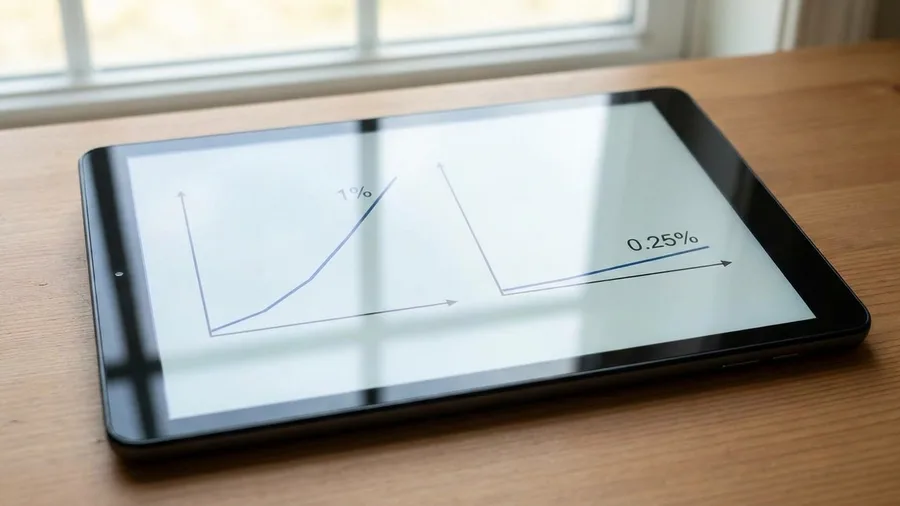
Put the same $100,000 on a 0.25% all-in cost and it finishes around $984,000 after 35 years, against roughly $769,000 under the 1% fee. That is about $215,000 of difference, and it is not a different market or a luckier decade. The only thing that changed between the two runs is the annual drag: 6.75% net instead of 6%.
The gap does not wait for year 35 to open. At 20 years the cheap version holds about $369,000 while the 1% version holds about $321,000, so by the point many people are within a decade of drawing on the money, close to $48,000 has already gone missing. Watching the two lines separate that early is what makes the arithmetic feel real rather than theoretical.
0.25% all-in is a reachable number, not a fantasy of free investing. It is what you tend to see when a portfolio of broad low-cost index funds sits alongside a low-cost automated advisory account. The funds still charge, the platform still charges; the weight is simply a quarter of a point rather than a full one.
What that lighter design does not come with is worth naming plainly. There is often no written plan sized to your situation, nobody's phone number to call when the market drops 20%, and no one sorting out an inherited account or a tax question that has tangled itself over years. Those absences are the trade, and they cost something even when the bill is small.
That is why the $215,000 belongs on the ledger as the cost of a service, not as money stolen. It answers a narrower question than it first appears to.
When the 1% Fee Is Worth It — and When It Isn't
Worth It
- You have a written financial plan you actually follow.
- You have a history of panic-selling in downturns.
- Your tax or estate situation is complex.
- You value a human on the other end of the phone.
Skip It
- Your portfolio is a simple three-fund mix.
- You have no estate or tax complexity.
- You have never sold in a panic.
- You are comfortable managing your own index funds.
Sometimes the 1% Earns Its Keep

The 1% is worth paying only when the service behind it would otherwise cost you more than the fee does. That is a high bar, and it is met more often than the fee skeptics admit and less often than the fee itself implies.
Consider what a good advisor actually delivers across a working lifetime: a plan written down and revisited as your life changes, quarterly rebalancing back to the targets you agreed, deliberate harvesting of losses to offset gains at tax time, and a voice on the phone during the weeks when everything feels broken, the kind of retirement rules that survived scrutiny. That last one is not soft comfort. It is often the most expensive thing the fee buys.
The panic math makes the point sharply. Say the balance is $725,000 and a bad year knocks 45% off it. Selling there locks in a loss of roughly $326,000, which is more than the entire $299,000 gap built over 35 years of paying 1%. One counselor who keeps you from hitting the sell button can be worth the whole fee difference, and sometimes more than once.
The test cuts the other way just as cleanly. A three-fund portfolio you set up and leave alone, no estate complications, no tax tangle, and no history of reaching for the sell button in a bad week: that is a profile where the service has little to actually do, and the fee is buying reassurance you may already have.
So the question is never whether 1% is good or bad in the abstract. It is whether the specific list of what your fee covers is worth $215,000 across 35 years and the annual dollar figure you are actually billed. Ask for the list in writing. If it is short, or the answers are vague, that tells you something too.
🔍 Your 3-Step Fee Audit
Request last year's total cost in dollars
Ask for the advisory fee plus fund expense ratios in writing.
Compare that total to a 0.25% alternative
Use an index fund or robo-advisor quote as a benchmark.
Decide: stay, negotiate, or move
Make it a deliberate choice, not a default drift.
Ask for Last Year's Fee in Dollars

The number you need is the total dollar cost charged to your account last year, advisory fee plus every fund expense ratio inside the funds, in writing rather than as a percentage. The 1% is almost never the whole bill. A portfolio of funds each charging 0.6% or 0.8%, on top of a 1% advisory fee, is an all-in cost closer to 1.7%, and the 35-year math runs on the all-in number, not the headline one.
So the ask is specific: last year's total cost to me, in dollars. Not the fee schedule, not the rate. The statement line with the actual amount taken.
Fund expense ratios are what each fund deducts from its own returns before you ever see a balance, which is why they never appear as a separate charge and why they are easy to forget when you are totting up what the relationship costs. Add the two, and you have the figure that belongs next to the 0.25% alternative: against roughly $984,000 over 35 years at that all-in cost, the gap you are actually weighing is measured from your own balance, not the $100,000 example.
One more question belongs in the same email, because it is easy to leave out: is the fee charged on cash sitting in the account waiting to be invested? Money parked between trades earning nothing while a percentage comes off it is a quiet extra cost, and the answer is usually one sentence.
Frequently Asked Questions
Is a 1% advisor fee really that bad?
It depends on what the fee buys. For a simple portfolio you would leave alone, the 28% gap over 35 years is hard to justify. But if the advisor provides a written plan and keeps you from selling in a panic, the fee may be worth it. The key is to know the dollar cost and the alternative.
How do I find out what I'm actually paying?
Ask for the total dollar amount charged last year, including advisory fees and fund expense ratios. Get it in writing. Then compare it to a low-cost index fund or robo-advisor quote.
Does the 28% figure apply to me if I plan to retire sooner?
No, the 28% is for a 35-year horizon. Over 10 years, the gap is about 9%; over 20 years, about 17%. The shorter your horizon, the smaller the fee's impact — and the more other factors like taxes and advice quality matter.
Should I move all my money to a 0.25% robo-advisor tomorrow?
Not necessarily. If you have a complex situation or a history of panic-selling, the human advice may be worth the extra cost. Run the numbers first, and consider your own behavior as part of the equation.
Can I negotiate the 1% fee?
Sometimes. It depends on the size of your account and the advisor's pricing structure. Ask if there is a breakpoint for larger balances or a lower-cost service tier. It never hurts to ask.
The 1% Is Defensible — If You Know What You're Paying For
The verdict is plain: a 1% fee is defensible where it buys a real written plan or stops a costly panic sale, and hard to justify on a simple portfolio you would leave alone anyway.
The 28% is not a scare number. It is what 1% on a growing balance does over decades. Put the same $100,000 on a 0.25% all-in cost and it finishes roughly $215,000 ahead of the 1% version – not because the lower fee is clever, but because more of the growth stays invested.
So before you change anything, make one request: last year's total cost in dollars, advisory fee plus every fund expense inside the funds, in writing. Hold that figure up against the 0.25% alternative. The number you decide with is the dollar cost on the statement, not the 1% label.