

Twenty minutes. That is the whole annual rebalancing job on a $240,000 portfolio split $168,000 in a stock index fund and $72,000 in bonds.
Next to quarterly rebalancing advice, a once-a-year glance can feel like neglect. It is a fair suspicion, and worth settling properly.
the calendar is not the mechanism. The 5-point band is. Extra checks mostly produce extra trades, and the trades are the only thing that costs anything.
Annual works here for three reasons. The band sits wide enough that most years nothing breaches it, the trade lands inside the 401(k) at $0 commission, and $1,500 a month of new contributions steers the mix between checks without selling a thing.
By the end you can pick a cadence for your own situation, know which account the trade belongs in, and run a twenty-minute routine on the first Saturday in January.
Once a Year Clears the Bar for Most Portfolios

For a two-fund portfolio sitting inside a workplace 401(k), twelve months between looks is enough. That holds for the $240,000 split here, and it holds for most savers who own the same shape of portfolio.
Here is the arithmetic behind it. Your stock sleeve can climb to $180,000 before it reaches 75%, and today it sits at $168,000. Stocks would need to beat bonds by a full $12,000 in relative weight to push through that line in a single year. A year like that happens, but it is not what a typical twelve-month stretch delivers.
Which means the first Saturday in January mostly looks like this: you divide $174,000 by $240,000, get 72.5%, see it sitting between 65 and 75, and close the browser tab. That is the system working, not the system failing.
The fund company that publishes its own rebalancing research has run this comparison for years, and its published figures point the same way. You can read the study yourself rather than take a performance claim from anyone. What it typically compares is annual slowness against more frequent attention, and the gap tends to be small.
Three holdings do flip this verdict, and they get their own section at the end. A concentrated or volatile slice that can swing past the band in weeks. A portfolio being drawn on in retirement, where every withdrawal shifts the weights. A year when a lump sum or a rollover lands and rewrites the mix overnight. If none of those describe you, twelve months stands.
| How often you look | Trades in a year | Time spent a year | Where the trade lands | Who it fits |
|---|---|---|---|---|
| Once a year | 0 or 1 | About 20 minutes | Inside the 401(k) at $0 commission | Two broad index funds mostly in a 401(k) |
| Every quarter | 0 to 4 | About 80 minutes | Inside the 401(k) at $0 commission | A volatile slice or a retirement income draw |
| Threshold only (65–75%) | 0 or 1 | About 20 minutes plus a monthly glance | Inside the 401(k) at $0 commission | Anyone who wants the calendar out of it entirely |
The Band Decides, Not the Calendar

The trigger is a 5-point drift from target, so on $240,000 the stock sleeve is allowed to run from 65% to 75%-$156,000 to $180,000 – while bonds hold the remaining 25% to 35%, or $60,000 to $84,000. January is simply when you look. The calendar is the habit; the band is the rule.
$187,200 in stock and $52,800 in bonds, which is 78/22. That is three points past the top of the band and $7,200 over the $180,000 ceiling. The mix is not wrong because the calendar said to check it; it is wrong because the drift crossed the line.
The fix restores the target, not a guess. You move $19,200 out of the stock fund and into the bond fund, and the portfolio lands back at $168,000 stock and $72,000 bonds – 70/30, exactly where it sits on a clean sheet.
Now the year the band is never breached.
⚠️ COMMON MISTAKE
The check is a test, not a task
A January check that finds the mix inside 65–75% is a success even if it ends in no trade at all. Placing a trade to feel productive is how a fine plan gets tinkered into a worse one.
Quarterly Checks Catch Drift Sooner but Trade More

A quarterly check tightens one thing only: how long a breach can run before anyone notices it. The mix is never more than three months stale, so a sharp equity move in, say, September gets caught in October rather than the following January.
What that sense of catching things early costs is easy to miss. Up to four sessions of about 20 minutes each is roughly 80 minutes a year, and every session is another chance to place a trade and another chance to tinker with a plan that was fine in March and fine again in December. Most of those trades exist to fix a drift that a wider band would have left alone.
At $240,000 in the boring three-fund index portfolio, the difference does not matter. The drift caught early is a couple of points, worth less than the trades and the attention it takes to go find it.
The reader quarterly does matter for is a different one: a concentrated or volatile slice, a portfolio being drawn for retirement income, a year with a lump sum or rollover. Those are the three cases named in the last section, and they are the only ones where the extra looks earn their keep.
Rebalancing terms, decoded
Definitions follow the way the terms are used in this article, not a textbook.
Do the Trade Inside the 401(k), Skip the Tax

Both accounts hold the same two index funds, so a $19,200 stock-to-bond move works exactly the same whether it lands in the $190,000 401(k) or the $50,000 Roth. The difference is what happens after you click submit.
Put it in the 401(k) and nothing does. Moving money between the funds inside the plan is not a taxable event, and the plan's index funds trade at $0 commission, so the rebalance costs you the twenty minutes on a Saturday and not one dollar more.
The size makes the account question sharper. $19,200 is nearly 40% of the $50,000 Roth, so putting the trade there would mean turning over almost half of that account in a single sale. In the $190,000 401(k) the same trade is about 10% of the balance, and it resets the whole portfolio to 70/30 either way. Same outcome, a fraction of the tax surface.
Sell inside the Roth and you realize a gain. How much of it you keep depends on your bracket, your holding period and the year you're in, and a rate quoted here would be a guess dressed as advice. IRS Publication 550 walks through capital gains and losses line by line, and it is the document to read before you sell anything in a taxable account.
There is a cheaper path still. Send the $1,500 monthly contribution at whichever fund is underweight first, and the mix closes the gap by adding money to the thin side instead of selling anything at all. No trade, no gain, no form.
A Twenty-Minute January Check You Can Copy

Open both accounts, write down two balances, and do two divisions. That is the whole morning. Every step below runs off the $240,000 total, so keep that number at the top of the page before you start.
First, the stock fund: $187,200 divided by $240,000 comes to 78%. Do the same for bonds and you get 22%, and the two should add up to 100 – if they don't, a balance is missing or one account got counted twice.
Now set 78% against the 65 to 75 band. It sits above the ceiling, which means a trade. Inside the 401(k), move $19,200 out of the stock fund and into the bond fund, and the mix lands back at $168,000 stock and $72,000 bonds, which is 70/30.
Set aside the first Saturday in January and the entire job takes about 20 minutes. Two accounts, two funds, one trade at most – there is nothing else to open, nothing to download.
The mistake happens while you're already logged in. The screen showing 70/30 invites you to change it, and that is a different decision entirely. The number you wrote down years ago reflects how much risk you chose to carry; the check restores it, it never re-sets it. If you genuinely want a different target, make that call on its own day, with its own reasoning.
Then write down the date, both balances, the two percentages, the trade if you placed one, and the 65 to 75 band in the same place. Next January you open that page instead of rebuilding the sum, and the check takes ten minutes. The page is also what stops you re-deciding the same question every year, because the answer is already written above it.
🗓️ The January check, in five steps
Pull both balances
Only the two funds' balances matter, not the account totals. Write each on one line.
Do the division
If stock and bond percentages don't sum to 100, you missed a balance or double-counted an account.
Compare with the band
Inside 65-75%: stop. Past it: trade. The band is the whole trigger – not a feeling about the market.
Place one trade if needed
Trade inside the 401(k) only: $0 commissions there, and a Roth sale would realize a gain – see IRS Publication 550.
Write it down
Date, both balances, both percentages, trade size, the band. Next January you open this page, not a calculator.
Point New Contributions at the Underweight Fund
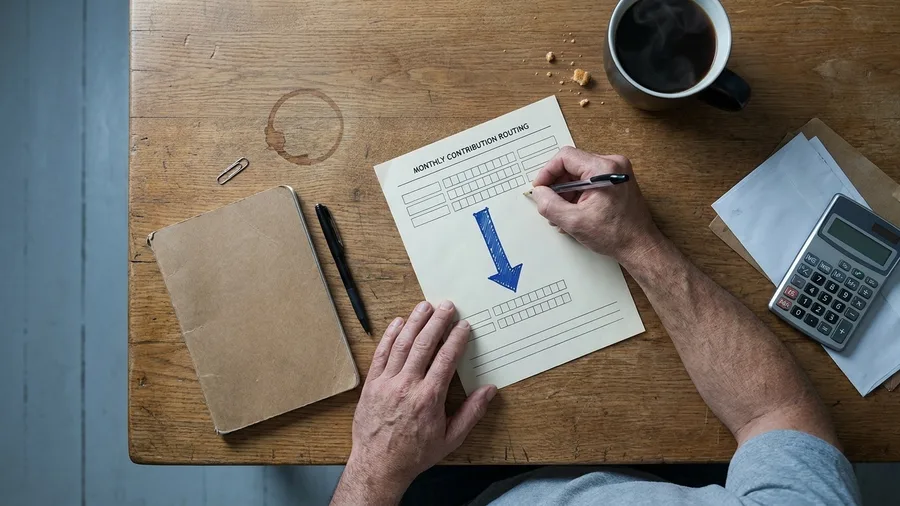
Most years you can skip the sale entirely. The $1,500 heading into the 401(k) every month – $18,000 over a year – can be aimed at whichever fund has fallen below its target, and the mix rights itself through buying rather than trading.
Run the math on the drift. One percentage point of $240,000 is $2,400, and at $1,500 a month a drift of a point or so closes in under two months of redirected contributions. Two points takes about three months. By the time January arrives, the gap is often gone, which is why the check finds nothing to do.
What it costs to set up: one visit to the contribution election screen, where you change the investment direction for future money. The existing balances stay exactly where they are and nothing gets sold, so there is no gain, no tax and no commission. If you'd rather not touch it again, let it sit pointed at the underweight fund until the next check shows you which one that is.
It runs out in three places. A drift already past the $180,000 ceiling needs a sale, not a redirect – the monthly flow is too slow to fix a breach. A lump sum or a rollover landing mid-year can swamp both the contributions and the band in a single deposit. And if both sleeves sit on target, there is nothing to point the money at, so leave it in the stock fund and move on.
None of this replaces the look. Contributions steer the mix; only the check tells you which way to steer, and only the two balances from that morning tell you whether the redirect is still pointed right.
Where the annual check holds up — and where it doesn't
Annual is enough
- Two broad index funds, 70/30 target
- Most of the balance inside a 401(k)
- No money being drawn for income
- No large lump sum or rollover this year
Check quarterly instead
- A concentrated or volatile slice in the mix
- Withdrawals taken from the portfolio in retirement
- A year with a lump sum or a rollover
- A single holding large enough to swing the band in weeks
When Once a Year Is Too Slow

Three holdings outgrow a twelve-month look: a portfolio carrying a concentrated or volatile slice, one being drawn down in retirement, and a year when a large lump sum or rollover lands in the account. Each can leave the 65-75% band long before the next January check finds it. A single volatile holding can cross the line in weeks rather than months, so the annual look leaves that risk running unattended for the rest of the year. A retiree who sells from the mix changes the weights with every withdrawal, and the account drifts as a side effect of paying the bills. A $100,000 rollover dropped into a $240,000 portfolio in June shifts every percentage point overnight, and the January check would be reading a portfolio that stopped existing in the spring.
The fail here is not frequency but a gap between a look and a move. When the holding has moved in weeks, an annual check is the wrong shutter speed. That is the case for a quarterly look on the same band rather than a separate rule: four dates, four twenty-minute sessions, the same 65-75% trigger. Each quarter gives you a chance to steer contributions before a sale is needed. A $240,000 portfolio at 70/30 can shed $12,000 of relative drift and still sit inside the band, but a volatile slice can turn that gap into a breach in a single bad month. If you would not trust a position to sit for three months, do not.
The other route is to stop checking by hand at all. A balanced or target-date fund rebalances internally, and the manager handles the timing without sending you a single trade or a tax question. You give up nothing except the control and the $0-commission trade you were doing yourself. For someone spending down the portfolio or holding one concentrated position they can't sell, the fund is the lower-maintenance answer. For a portfolio of two broad index funds mostly inside a 401(k), none of this changes the math, and January stays enough.
Frequently Asked Questions
Is checking my portfolio once a year really enough?
For a two-fund 70/30 portfolio held mostly in a 401(k), yes. On $240,000 the stock sleeve has to reach $180,000 before the 65–75% band is breached, and most years it does not get there. A breach like the 78/22 example in this article is the exception, and it is what the annual check exists to catch.
Should I rebalance on a schedule or when the band is breached?
Set the schedule for the look and the band for the trade. January is the habit; 65–75% is the rule. If the mix sits inside the band in January, do nothing. If it sits outside in July, a threshold-based check would catch it — which is why the quarterly rule exists for the holdings named in the last section.
How do I avoid taxes when rebalancing?
Place the trade where the tax consequence is smallest — the 401(k) in this example, at $0 commission, rather than the taxable account or the Roth. A sale inside a tax-advantaged account still has rules; for how a realized gain is treated, see IRS Publication 550, and run your own numbers with a CPA if the amount is large.
What is the 5% band and where did it come from?
It is the drift trigger used throughout this article: stocks allowed between 65% and 75% around a 70% target. It is our own rule of thumb rather than a citation, sized so ordinary drift does not trigger trades while a real breach does. A tighter band means more trades; a wider one means more drift.
Can I rebalance without selling anything?
Yes — redirect the $1,500 monthly 401(k) contribution at the underweight fund. One percentage point of $240,000 is $2,400, so a couple of points is a few months of contributions. It is not enough if the mix has already crossed the band, when the sale still happens.
Does rebalancing actually improve returns?
It controls risk rather than raising returns. The fund companies' published rebalancing studies show the annual and threshold schedules landing close to the more frequent ones once trading costs and taxes are counted; the exact performance figures vary by period. The job of the trade is to put the mix back where you decided it should be, not to beat the market.
Put the First Saturday in January on the Calendar — With 65–75% Written Next to It
Annual is the right cadence for a two-fund 70/30 portfolio held mostly inside a 401(k). Quarterly is the right cadence for exactly three holdings — the concentrated or volatile slice, the retirement income draw, and the lump-sum or rollover year — and nobody else.
The single first step is to put the first Saturday in January on the calendar and write the 65–75% band next to it, along with the $240,000 total the band is measured against. When January arrives, pull two balances, do one division, and place at most one trade inside the 401(k). Twenty minutes, once, against a $19,200 swing. The returns say that is enough.