

Pick the wrong country and you can lose $700 a month for as long as you live there. That is $8,400 a year, and it is the gap between a retirement that breathes and one where you flinch at the register.
At home, $2,000 a month reads as a studio apartment and a bus pass. Abroad, in the nine places below, the same figure covers five separate lines: rent, utilities, groceries, local transport, and a basic private-health or out-of-pocket fund. Every one of the nine totals under the cap in 2026, from $910 in Da Nang to $1,440 in Atenas. So the budget is not the puzzle. The cushion is the choice, and what is left over after the bills, $1,090 in Vietnam against $560 in Costa Rica, is the clearest measure of what each place asks of you in return.
By the end you can rank all nine against your own priorities and know which two or three deserve a scouting trip, and which official rules to check before you book it.
Look at the two ends first. The $2,000 you already have pays five lines in nine walkable cities. What it buys you beyond that, and what it costs you, is the part worth comparing.
Quick Tips Before You Start
Do a scouting trip first
Spend at least two weeks in a rental in the actual neighborhood before you commit to a lease.
Price health coverage
Get a quote for private insurance or a local public option before you fall in love with a place.
Check visa income rules
Some countries require proof of monthly income; verify the current threshold on the official government site.
Keep a US bank account
You'll need one for Social Security deposits and emergency transfers; don't close it.
Learn basic Spanish or Portuguese
Even 50 words of the local language changes daily life outside the expat bubble.
1. Mérida, Mexico: Colonial City on a Budget
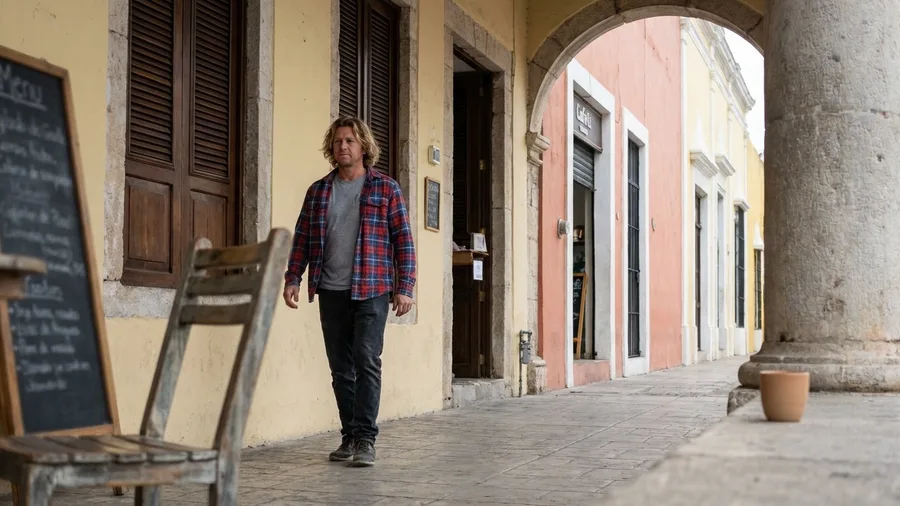
The first time I walked the Centro at two in the afternoon, the thermometer read 96 degrees and the calle was nearly empty. Everyone I knew was indoors, behind a fan, waiting for the light to go orange. That afternoon taught me more about Mérida than any guidebook chapter ever could.
The rent line here is the one most US retirees recognize. Five hundred fifty dollars a month gets a place inside the colonial grid, the same square of streets where the cathedral and the plaza sit, and that figure lands roughly in the middle of what the Americas half of this list charges for a walkable center. It is not the cheapest rent you will see. It is the rent of a city that already has an expat infrastructure, a hospital cluster, and a Spanish school on every other block, and you are paying for that.
Add the honest lines: $90 for utilities (low because the winter months need no heat and no air conditioning), $300 for groceries, $60 for local transport, and $120 into a health fund for a private consultation or an out-of-pocket visit. The total lands at $1,120. Two thousand minus that leaves $880 in your hand at the end of the month.
What does $880 buy in Mérida that Mérida itself does not give you? A week or two of travel, dinner out several times a week at places the neighbors actually eat, a cushion against the peso moving against you. Only one city on this half of the list leaves more slack, and that is a city you have already read about or will read about shortly. This is a well-padded position.
Now the cost side, because the trade-off is not the rent. It is the heat. Six months of the year, the afternoons are a wall you cannot walk through without planning around it. Errands happen early. Lunch is long. Anything outside between noon and four is a negotiation with your own body. That heat is also why the utility bill stays at $90 instead of climbing to twice that, so the thing that makes you stay inside is also the thing that keeps the money on the page.
And the language. Mérida is not a place where English will carry you through the market, the pharmacy counter, or the water bill. It is a place where two hundred hours of Spanish, done before you land, changes every single day you spend there. Retirees who arrive without it feel isolated for months, not weeks. Retirees who arrive with it are invited to dinner.
Is the trade worth it? If you want the colonial streets, the warm weather that never quite gets cold, and a city that has been doing this for decades, and you can tolerate a Spanish-only daily life and an afternoon siesta you did not ask for, the answer sits in that $880 cushion. It is the price of the heat, the language, and the walkable streets, and it is a comfortable price to pay.
Residency and health-coverage rules for Mexico are set by the Mexican government. Check the current requirements directly with official sources before you book anything; there is no income threshold stated here.
💡 Tip: Rent in the Centro for the walkability, but ask about blackout curtains and a backup fan before you sign—afternoon sun through colonial windows is no joke.
| Place | Rent | Utilities | Groceries | Transport | Health fund |
|---|---|---|---|---|---|
| Mérida, Mexico | $550 | $90 | $300 | $60 | $120 |
| Cuenca, Ecuador | $450 | $70 | $260 | $40 | $100 |
| Medellín, Colombia | $600 | $80 | $280 | $50 | $130 |
| Boquete, Panama | $650 | $100 | $350 | $80 | $150 |
| Atenas, Costa Rica | $700 | $110 | $380 | $90 | $160 |
| Chiang Mai, Thailand | $450 | $80 | $250 | $50 | $120 |
| George Town, Penang | $500 | $70 | $260 | $50 | $110 |
| Da Nang, Vietnam | $450 | $80 | $240 | $40 | $100 |
| Braga, Portugal | $750 | $120 | $350 | $60 | $150 |
2. Cuenca, Ecuador: Andean Retirement Value

The belief that keeps a lot of people out of Cuenca: a walkable historic center means a high rent. The people who say it haven't looked at El Centro's numbers. Rent runs $450 – the joint-lowest on this list – which is the reason the total at the bottom of the column comes in below Mérida's and gives the same colonial-grid walkability with a mild, spring-like climate instead of the heat.
The five fixed lines: $450 rent, $70 utilities, $260 groceries, $40 local transport, $100 health fund, total $920. That is $1,080 of cushion under the $2,000 cap, every month. The cushion covers travel, classes, dinner out, and a standing contingency fund. Same life as a colonial city with tropical summers, $100 more left over – and the trade is that the language matters more outside the expat orbit, since the plumber and the pharmacist are not going to switch for you.
The walkability of the historic center is the amenity. The mild climate is the second one. The $1,080 is the part you can spend. Residency and health-coverage rules are worth checking directly with Ecuadorian government sources before any scouting trip; no income threshold is stated here.
💡 Tip: The historic center is walkable but hilly—test a few blocks before you commit to a place without an elevator.
⚠️ COMMON MISTAKE
Don't sign a lease before a scouting trip
Photos lie. A street can be noisy at night or a 'walkable' neighborhood can be a 20-minute walk from the grocery store. Book two weeks in a short-term rental first, and walk the exact block you're considering at different times of day.
3. Medellín, Colombia: Big-City Comfort on $1,140

Six hundred dollars a month in rent is the number that decides Medellín for most people: it buys a flat in Laureles, a residential neighborhood with restaurants and transit at street level, where the sidewalks are flat and the walk to the grocery is short.
The whole month comes in around $1,140. Utilities $80, groceries $280, transport $50, health fund $130. Against the $2,000 cap, that leaves $860. It is the tightest slack of the three places in the Americas covered so far, and it is still a wide, comfortable margin, because you are paying the city premium in exchange for everything a metro of two and a half million provides that a small historic center cannot: restaurants at ten at night, an actual transit system, a hospital network, a flight from the international airport to anywhere.
If $1,140 sounds like more than your monthly pension covers today, start at $250 or even $100 into a dedicated Medellín fund, automated on the first of the month. That is not a rounding error. It is a decision made once that keeps the number in front of you instead of arriving as a surprise six months before you plan to move.
The same principle scales down further. Ten dollars a week into a savings account earmarked for this is more useful than a spreadsheet you never open, because automation removes the choice from the part of the brain that negotiates with itself at the end of a long day.
The trade-offs here are real, not cosmetic. Traffic in Laureles is loud at rush hour. The city is bigger than the quiet neighborhood streets suggest, and noise travels. You are choosing the biggest city on this half of the list, and that size is exactly what the $220-a-month premium over a small Andean historic center buys: restaurants, transit, and the infrastructure that a metro brings with it, at the cost of the silence.
Residency and health-coverage rules for Colombia come from Colombian government sources. Check them directly before planning a scouting trip; no income threshold is stated here.
Monthly Cushion: Da Nang vs. Braga
How much of the $2,000 is left after fixed costs — our illustrative example
Percentages are the share of the $2,000 monthly budget left over in our example.
4. Boquete, Panama: Cool Highlands for $1,330

Pay $650 for the town center itself, because in Boquete that is what you are buying. This is where the list stops being about cities and starts being about a highland town at 1,000 meters, where the air is cool enough that nobody needs much of an air conditioner and the outdoors is the whole point. Medellín's restaurants and noise give way to hills, coffee farms and a walkable core small enough to cross on foot.
The five lines come to $1,330: rent $650, utilities $100, groceries $350, transport $80, health fund $150. That leaves a $670 cushion under the $2,000 cap, and the transport line is the tell – it is the highest so far on the list not because Boquete is sprawling but because the trails, the farms and the bigger towns you will want sit outside the center and you get to them by bus or by car.
The automation is what makes this one hold. Set a $670 monthly transfer into a separate account the day the $2,000 lands, earmarked for outdoor gear, travel and a contingency fund, and leave it alone until a real expense arrives. Then set the rent on a standing transfer to the landlord, and put the health fund $150 into its own account and don't touch it – a cooler climate hides costs, and a $150 buffer per month is a $1,800 year that absorbs a cracked tooth, a flight home or a replaced pair of hiking boots without touching the rest.
The trade is services. Fewer big-city hospitals, fewer specialists, fewer restaurants open past nine, and the nearest large airport is a drive rather than a taxi ride. That is the $190 a month difference from the city before it, and it is worth it only if the outdoors is what you actually want – not if you are moving here for convenience and hoping the town grows into it.
💡 Tip: If you don't plan to own a car, budget for taxis or a private driver for grocery runs—the $80 line is realistic, not generous.
Atenas, Costa Rica — At a Glance
🏠 Rent
$700
💡 Utilities
$110
🛒 Groceries
$380
🚌 Transport
$90
🏥 Health fund
$160
💰 Monthly cushion
$560
Why it stands out
Highest grocery and transport lines on the list, and the smallest cushion of the nine—but year-round spring weather and easy access to San José.
5. Atenas, Costa Rica: Central Valley Value

Yes, but it leaves the smallest cushion on the list, and that is the honest reason to think twice or think smaller. Rent runs $700, utilities $110, groceries $380, transport $90 and the health fund $160, for a total of $1,440 and $560 left over – less slack than anywhere else here, and the highest grocery and transport lines of the nine.
So you do not have to do the full move at once. Give yourself a scouting month first – a short-term rental, not a lease, and a budget of $1,600 to cover it – and see whether the year-round spring and the small-town pace earn the $110 more a month over the highland town before it. If they do, set up the $560 cushion as an automatic transfer and leave it alone; if they don't, you have spent one month and learned it without signing anything.
💡 Tip: Scale back by choosing a slightly smaller rental or a neighborhood a few blocks from the center—every $100 off rent adds $100 to your cushion.
6. Chiang Mai, Thailand: Low-Cost City Living

Price the month before you book the flight: a one-bedroom in Nimman, the grid of cafés and night markets just west of the old city wall, runs about $450. That matches the cheapest rent anywhere on this list, and it is the single figure that pulls the whole budget down.
Add the other four lines and the month lands at $950: $80 for utilities, $250 for groceries, $50 for local transport, and $120 into a health fund. Against $2,000 that leaves $1,050 unspent, more slack than any place in the Americas except one Andean city, and the arithmetic of this list has now turned direction entirely.
What that leftover actually buys is the part worth sitting with. It covers trips south to the islands, dinners out several nights a week, and a health contingency that grows instead of shrinking, because the money not spent on rent keeps stacking month after month. Watch what the low rent is really paying for: a rented room in a city where you cannot read the lease.
The friction here is not financial. Thai residency rules and the language barrier are what will test you, and both need checking against Thai government sources directly before you commit, especially the visa category and what private health coverage you can actually hold.
Set a real deadline on it anyway. Pick a month six to nine months out, price a two-week stay in Nimman for that window, and put the $950 figure against your own bank statement the same week you do.
Where the $2,000 Goes in George Town, Penang
Illustrative 2026 monthly budget for one retiree — our planning example
Percentages are our illustrative planning split, not measured population data.
7. George Town, Penang: Island City on $990

The worry is that an island city with a UNESCO core has to cost more than the inland alternative, and at $990 a month total, it doesn't. A rental in the George Town grid runs $500 a month, and that grid is the whole point: hawker stalls, shops, and public transit all sit inside walking distance, so you are paying for a location where the street does the work a car would do elsewhere.
The rest of the arithmetic stacks up the same way it does inland. Utilities come to $70, groceries $260, local transport $50, and a basic health fund $110, which brings the month to $990 and leaves $1,010 of the $2,000 unspent. Forty dollars a month more than the Thai version of this life, and what those forty dollars buy is coast, transit, and a street food culture that runs Malay, Chinese, and Indian out of the same block.
I spent eleven days in a $500-a-month flat a few streets off the heritage zone, and what stuck was the food bill, not the rent. Breakfast of roti and teh tarik at a corner stall came to about 8 ringgit, roughly $1.75, and I ate lunch at a hawker center for less than $3 more days than not. The $260 grocery line is not deprivation here – it is a choice to cook some nights when the stalls are already cheap.
Here is the trade-off, and it is not financial. The humidity sits in the high 80s most of the year and the traffic in the heritage core is genuinely bad at rush hour, which is why the $50 transport line is worth spending on transit rather than assuming you will walk everywhere in that heat.
The $1,010 cushion is what makes the place liveable rather than merely affordable. It covers travel – Penang is a hub for cheap regional flights – plus dining out and a contingency fund, and it is the money that turns a scouting trip into a decision without draining the budget.
If you are coming from a cheaper Asian city and wondering whether the jump is worth it, run the comparison on what the cushion buys, not the total. $1,010 is slack you can spend on the things the island does not give you for free.
Before booking anything, check the residency and visa rules and health-coverage eligibility directly with Malaysian government sources. Those are the numbers that can change the whole calculation, and no budget line here accounts for them.
💡 Tip: The best hawker stalls don't advertise—follow the lunchtime crowd and the shortest menu.
8. Da Nang, Vietnam: Beach City for $910

The fear with the cheapest option is always that it is cheap for a reason – that the beach view hides a catch, and the monthly total of $910 confirms something is being given up. What is given up in Da Nang is the island grid and the three-cuisine street food, not the modern conveniences: rent runs $450 in Son Tra near the beach, utilities $80, groceries $240, transport $40, and a health fund $100. That $910 leaves a $1,090 cushion, the largest of the nine places here.
The check-in matters more than the arrival. Once a quarter, look at three lines only: what the rent actually renewed at, since a $450 lease can move at renewal; the health fund, because private coverage eligibility and cost are the line that shifts first with age; and the cushion, to confirm it is still $1,090 and not quietly spent on travel. The grocery line at $240 gives the most room to drift, so it is the one worth watching monthly.
Everything else – the language barrier, the hot and humid summers – is a known cost, budgeted for in advance. Residency and health-coverage rules need checking against Vietnamese government sources directly before any commitment.
The $520 Gap: What Braga's Extra Cost Actually Buys
Da Nang, Vietnam
- Rent cushion: $1,100 between lease renewals
- Health line: $100/month, re-quote annually after 60
- One flight home per year fits the $1,090
- Visa runs: check the current entry rule before signing a lease
- Tipping point: groceries above $310 erodes the lead
Braga, Portugal
- Rent cushion: $440 between renewals — tighter than it looks
- Health line: $150/month; residency path may open public cover
- One flight home per year eats most of the $570
- Currency: euros, no exchange drift on the rent
- Tipping point: rent above $820 turns the budget into a stretch
9. Braga, Portugal: European Comfort for $1,430

The fear is that a European city is the one place where the budget finally breaks, and Braga is where it comes closest without doing so. Rent is $750 a month in the city center, the highest on this list, with utilities at $120, groceries $350, transport $60, and a health fund $150, for a $1,430 total and a $570 cushion. That is the second-smallest leftover of the nine, and the $750 rent is what eats the difference.
That is why the timing earns its own paragraph. Currency moves against a fixed dollar budget, and a 10% swing on the euro turns $1,430 of expenses into roughly $1,570 without a single price changing in Braga – still under $2,000, but the cushion drops to about $430. Locking in the exchange rate on a portion of your income, or starting the residency paperwork this year rather than next, is the move that compounds in your favor, because the paperwork timeline is the thing you cannot compress later.
What the cushion buys is feel rather than slack: a mild climate, a walkable Portuguese street, and Porto down the line. Check residency, visa, and tax rules with Portuguese government sources before committing; no income threshold is stated here.
💡 Tip: Look for a rental a few blocks outside the historic center—you'll save $100–$150 a month and still walk to everything.
🗺️ How to Choose Your Place in Three Steps
Check the cushion
After fixed costs, how much is left for travel, dining, and surprises?
Test the climate
Can you live with the heat, humidity, or altitude for a full year?
Verify the rules
Residency, visa, and health-insurance eligibility must be checked with official sources.
Book a scouting trip
Spend two weeks in the neighborhood before signing a lease.
Set up your banking
Keep a US account for Social Security and transfers.
Frequently Asked Questions
Is $2,000 a month enough to retire abroad in 2026?
Yes, in the nine places listed here. Each budget covers rent, utilities, groceries, local transport, and a basic health fund, and all total under $2,000. The cushion—what's left after fixed costs—ranges from $560 in Atenas to $1,090 in Da Nang.
Which place has the lowest monthly costs?
Da Nang, Vietnam, totals $910 a month in our example, leaving a $1,090 cushion. Cuenca, Ecuador, is close at $920, and Chiang Mai, Thailand, is $950.
Do I need to speak Spanish or Portuguese?
It helps, but it's not required in the expat-heavy areas. In smaller towns like Atenas or Boquete, basic Spanish makes daily life easier. In Da Nang or Chiang Mai, the language barrier is the real friction, not the money.
How do I check visa and health-insurance rules?
Use official government sources for each country—immigration websites, consulates, and tax authorities. Rules change, and no article can replace checking the current requirements for your situation.
Should I rent or buy?
Rent first. A scouting trip and a short-term lease let you test the neighborhood, the climate, and the daily routine before you commit. Buying adds legal and tax complexity that varies by country.
What about taxes?
Tax rules for US citizens abroad are specific to your income and situation. Talk to a CPA who handles expat taxes before you move.
Match the place to your cushion, not your fantasy
All nine pencil out in 2026, from $910 to $1,440 with a health fund already counted. The question is not whether $2,000 works. It is which leftover you can live on.
If budget rules, Da Nang leaves you $1,090 and Chiang Mai $1,050 inland. If health care rules, Atenas carries the largest health line at $160 and still fits at $1,440, with Braga as the European version on a $570 cushion. Warm year-round points to Da Nang or Chiang Mai, both above $1,000 left over. A European feel points to Braga, walkable and mild at $1,430. Verify residency, visa, tax and health-insurance eligibility with official government sources before booking a scouting trip. No income threshold is stated here.
And that $700 a month you can lose by choosing wrong? It is mostly rent. Cuenca, Chiang Mai and Da Nang run about $450. Braga runs $750. Start there, compare the leftovers, and the country picks itself.
Pick your top two and check the rent
Open a rental site for the neighborhood you're considering and see what $500–$750 actually gets you this month. That's the first real number.